Whoever does not govern by what Allah has revealed is a Kāfir, according to the consensus of all Muslims
Whoever does not judge by what Allah has revealed — nowadays this refers to those who place the decisions and opinions of human beings in legislation above the judgment of Allah. This is clear and manifest Shirk, on the same level as the shirk of someone worshipping a statue.
Allah is the Creator of mankind, and He has the right to judge over His creation and to determine what is lawful and unlawful for them. Whoever believes that Allah’s judgment has no validity in any aspect is a Kafir according to the consensus of all Muslims. Whoever establishes, legislates, writes down, or sets up anything in place of Allah’s judgment is a Kafir according to the consensus of all Muslims.
For he has committed shirk by attributing Allah’s exclusive right to rule absolutely over His creation to a human being. He is just as much a non-Muslim as someone who denies the existence of Allah.
This issue is not the reason why the Khawarij were refuted. For the Khawarij claimed that the mere committing of a sin constitutes ruling by other than Islam. They made no distinction between failing to act according to Islam and establishing an alternative legislation. A sin is not disbelief as long as it is not declared lawful or legitimized.
Statements of the classical scholars
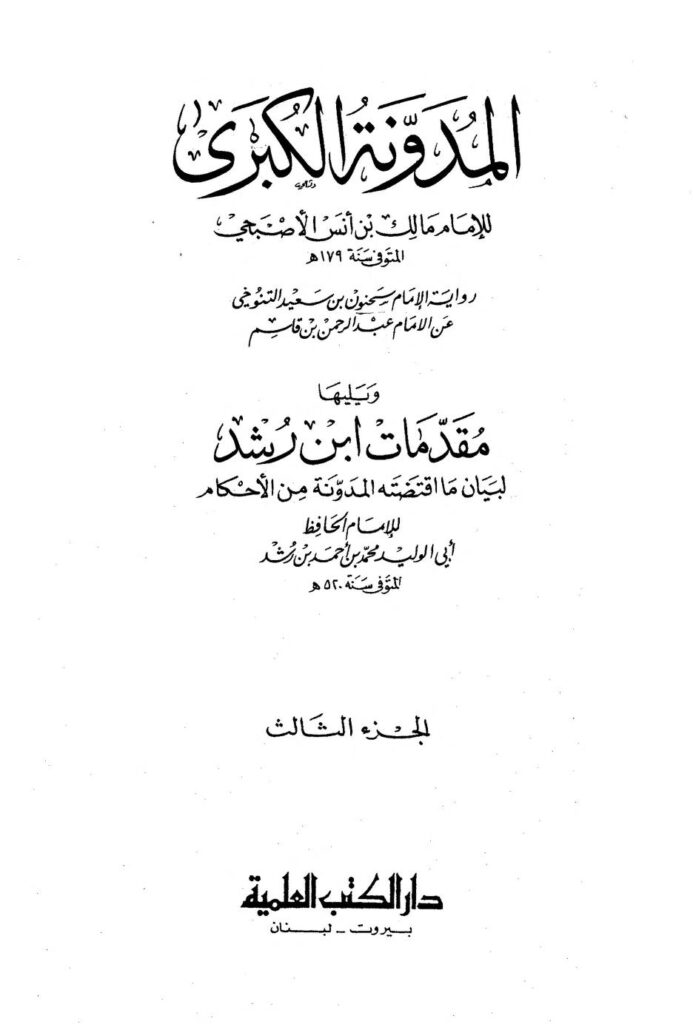
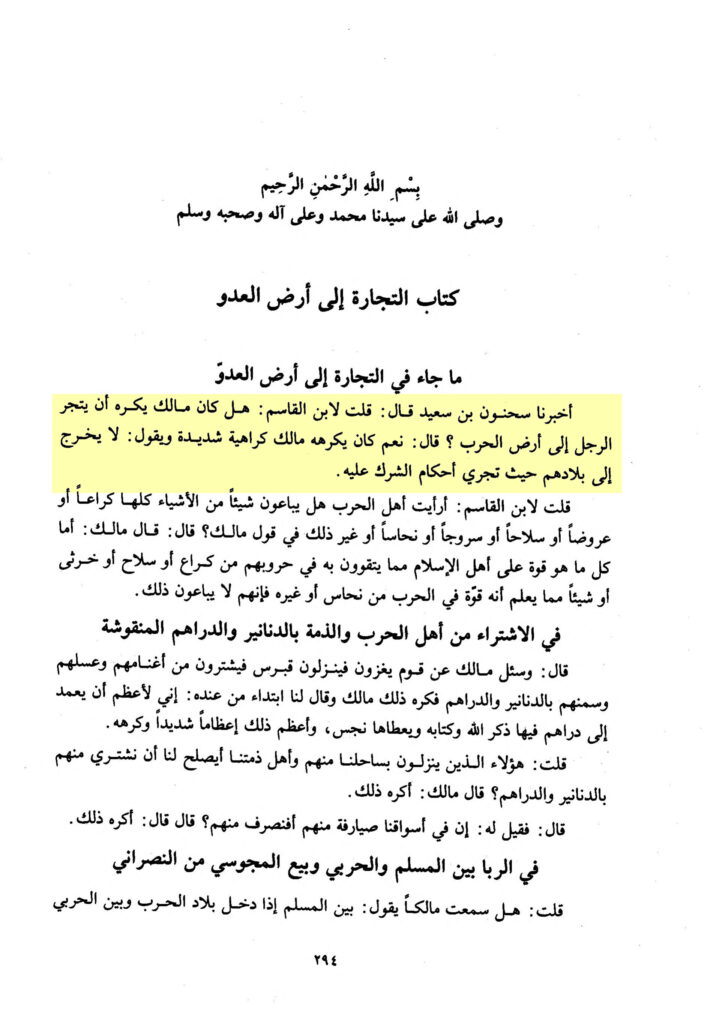
Imām Saḥnūn al-Mālikī (d. 240 هـ) transmitted from Imām Mālik bin Anas (d. 179 هـ) from the Salaf that the laws that contradict Islām are the laws of Shirk:
“Saḥnūn bin Sa’īd reported to us, he said: I said to Ibn al-Qāsim (d. 191 هـ): ‘Did (Imām) Mālik detest that the man trades in the land of war?’ He (Ibn al-Qāsim) said: Yes, (Imām) Mālik detested it in strong aversion and said: ‘He does not go out to their countries, where the rules of Shirk prevail upon him‘”
Imām Mālik from the Salaf mentioned here the laws that contradict Islām as laws of Shirk. At that time, the views of the Khawārij were already widespread and well known – especially to the great scholars of the Salaf, such as Imām Mālik. The narrations that the Madkhalīs and other enemies of Islām misuse from Ibn ‘Abbās and others were also well known. Nevertheless, Imām Mālik mentioned that the law that contradicts Islām is the law of Shirk – and that is exactly our statement. If it were possible, as the Mushrikūn claim, for a Muslim to be the originator of these laws, then it would be impossible to describe them as the laws of Shirk. For enticing Shirk is Kufr and if establishing Shirk and forcing people to submit to it is not enticing, then what is? So either they must abandon their lie or claim ignorance for one of the greatest scholars of the Salaf, Imām Mālik. Their lie and their Kufr have thus become apparent once again.
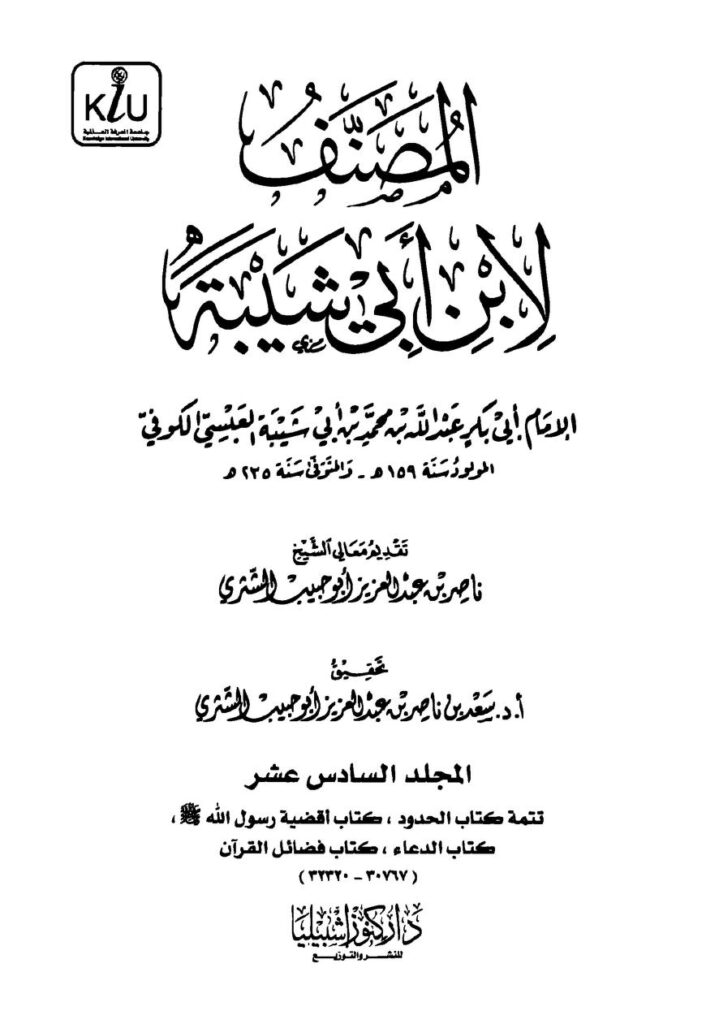
Imām Ibn Abī Shayba (d. 235 هـ) narrated:
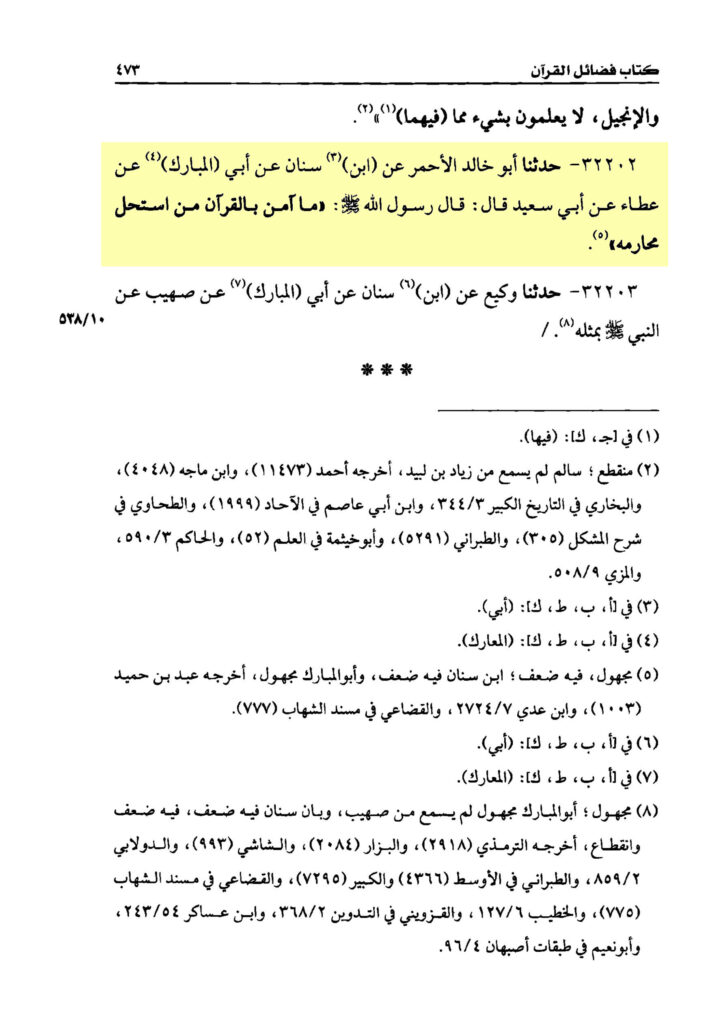
Abū Khālid al-Aḥmar narrated to us from (Ibn) Sinān from Abī (al-Mubārak) from ‘Aṭā’ from Abī Sa’īd, he said: The Messenger of Allāh said, may Allāh’s peace and blessings be upon him, said:
“Whoever regards its Ḥarām as lawful has not believed in the Qur’ān”
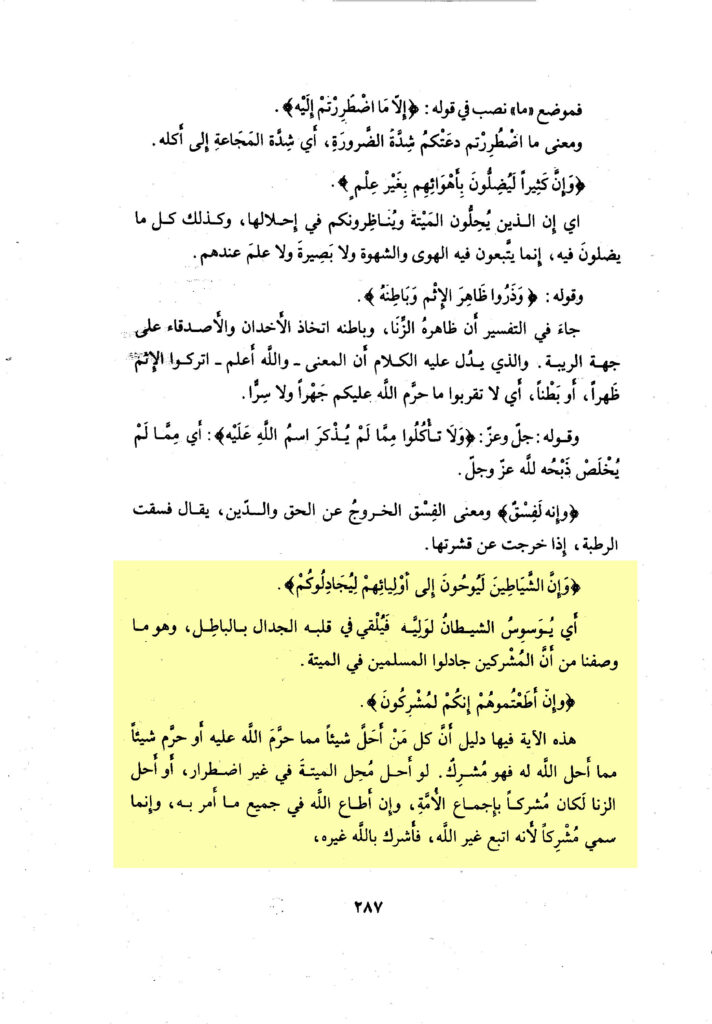
Imām Abū Isḥāq az-Zajjāj (d. 311 هـ) said that allowing what Allāh made Ḥarām is Shirk by Ijmā’ of the whole Umma:
«And indeed, the Shayāṭīn surely inspire their friends to argue with you» [6:121]
“This means, the Shayṭān whispers to his friend (the Mushrik), and then casts the argument with falsehood in his heart. And it is what we described, that the Mushrikūn argued with the Muslims about the (prohibition in the Sharī’a of the unslaughtered) dead animal”
«And if you obey them, indeed you are surely Mushrikūn» [6:121]
“This verse contains proof that everyone who allows something from what Allāh made Ḥarām for him, or forbids from what Allāh made Ḥalāl for him, is a Mushrik. If someone were to allow the (eating of the unslaughtered) dead animal, without compulsion, or if he were to allow Zinā, he would be Mushrik by the consensus (ijmā’) of the Umma, even if he obeyed Allāh in all of what He commands him. And truly, he is named Mushrik, because he followed other than Allāh. Thus, he committed Shirk with Allāh (by referring to) others“
The exclusion of Imām az-Zajjāj “without compulsion”, when talking about someone allowing the eating of the unslaughtered dead animal, is referring to the Shar’ī matter when one is about to starve.
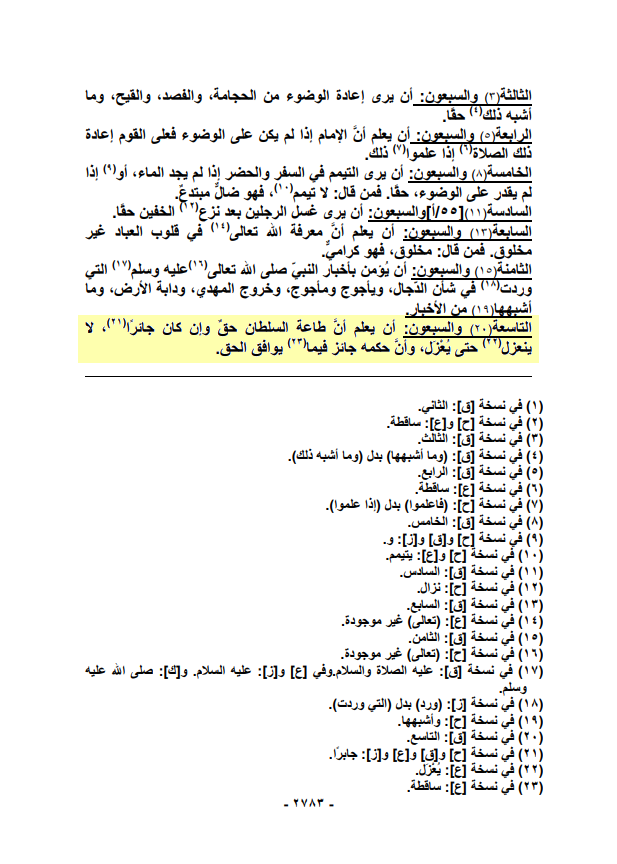
Muḥammad bin al-Faḍl al-Balkhī (d. 319 هـ) said that the rule of the ruler is permissible, if it is in accordance with the Sharī’a:
“79th: That he knows that the obedience (ṭā’a) of the ruler is a right; even if he was unjust, he is not removed (from office) until he is removed. And that his rule is permissible in that what is in accordance with the truth (Sharī’a)”
The obedience to the ruler is contingent on his rule being in accordance with the Sharī’a. Even if he was unjust, he is not to be disobeyed. But if his rule is not in accordance with the Sharī’a, his rule is never considered legitimate.
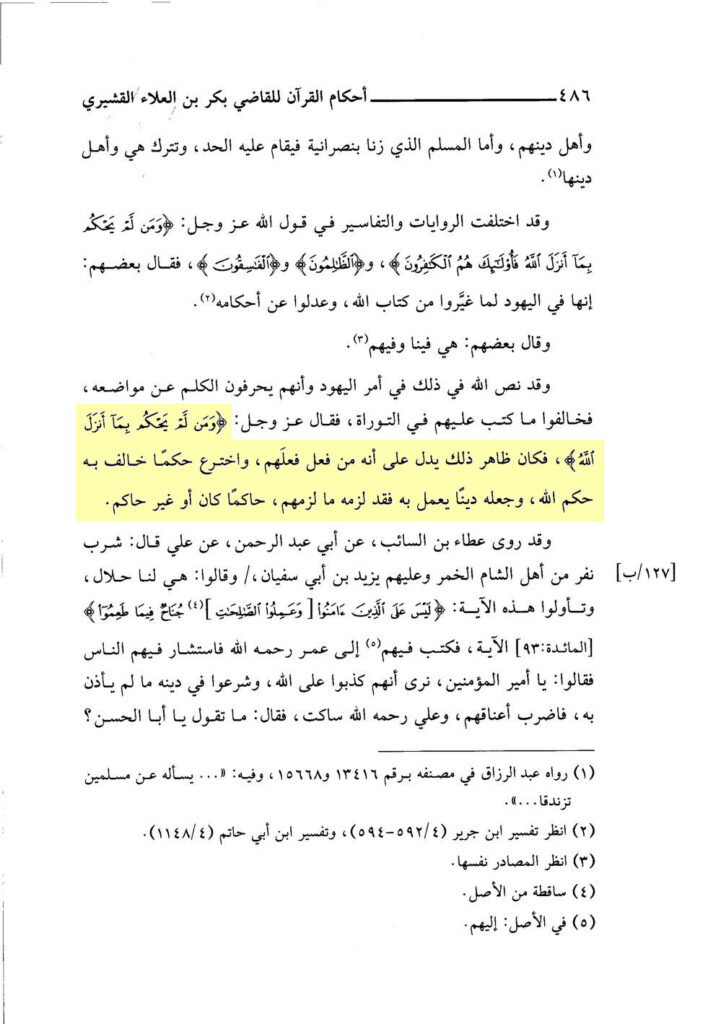
Qāḍī Bakr bin Muḥammad al-Mālikī (d. 344 هـ) said that whoever invents something that contradicts the ruling of Allāh is a Kāfir:
«And whoever does not judge by what Allāh has revealed» [5:44]
The obvious (meaning) of this indicates that whoever performs their act, invents a ruling that contradicts the ruling of Allāh, and makes it a Dīn by which is acted upon, then indeed, it is imposed upon him what is imposed upon them (i.e., that he is a Kāfir), whether he is a ruler or not.
This is exactly our position. Whoever invents something that contradicts the ruling of Allāh, imposing it as something to be acted upon, is certainly from the Kāfirūn. Qāḍī Bakr did not specify that one must claim it to be the ruling that Allāh revealed. Rather, he was content with stating that they are Kāfirūn if they invent a ruling that contradicts the Sharī’a.
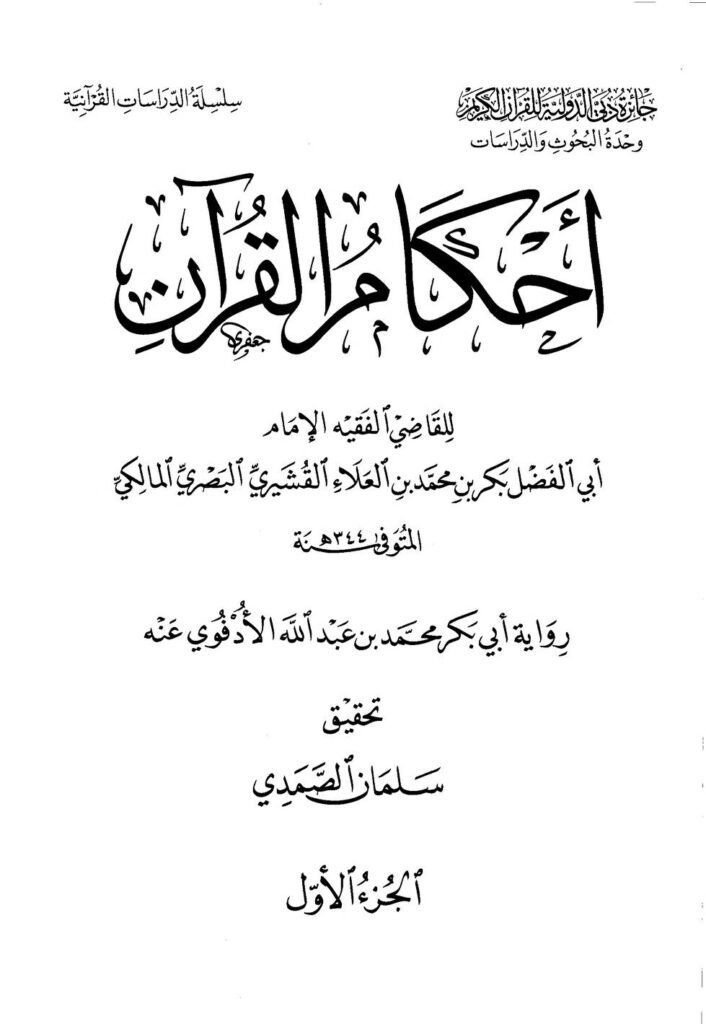
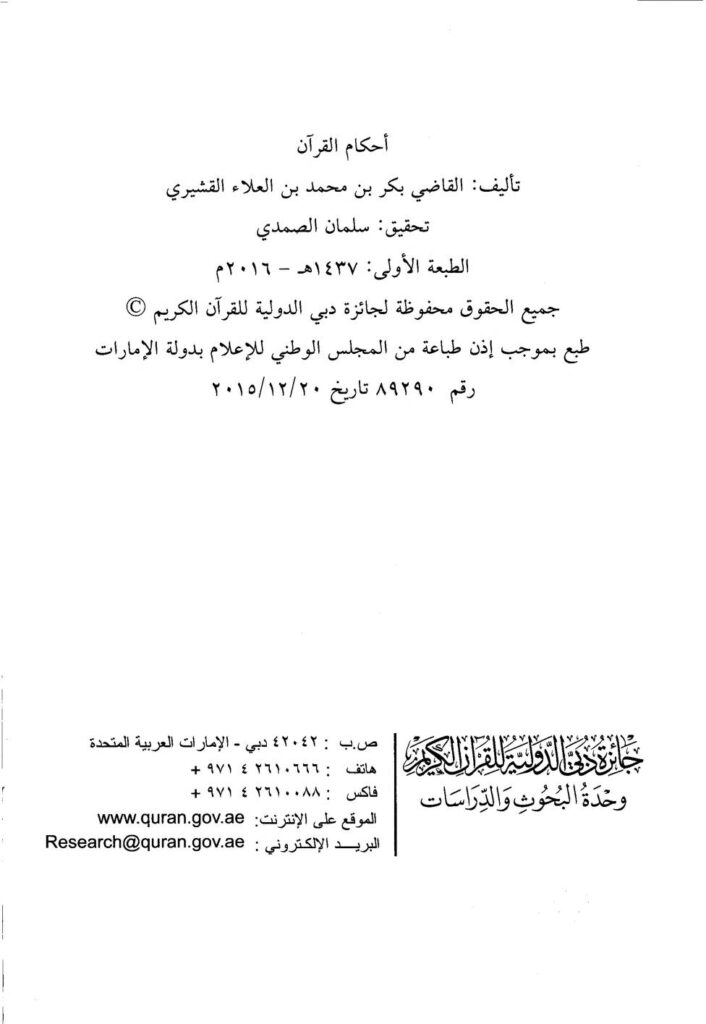
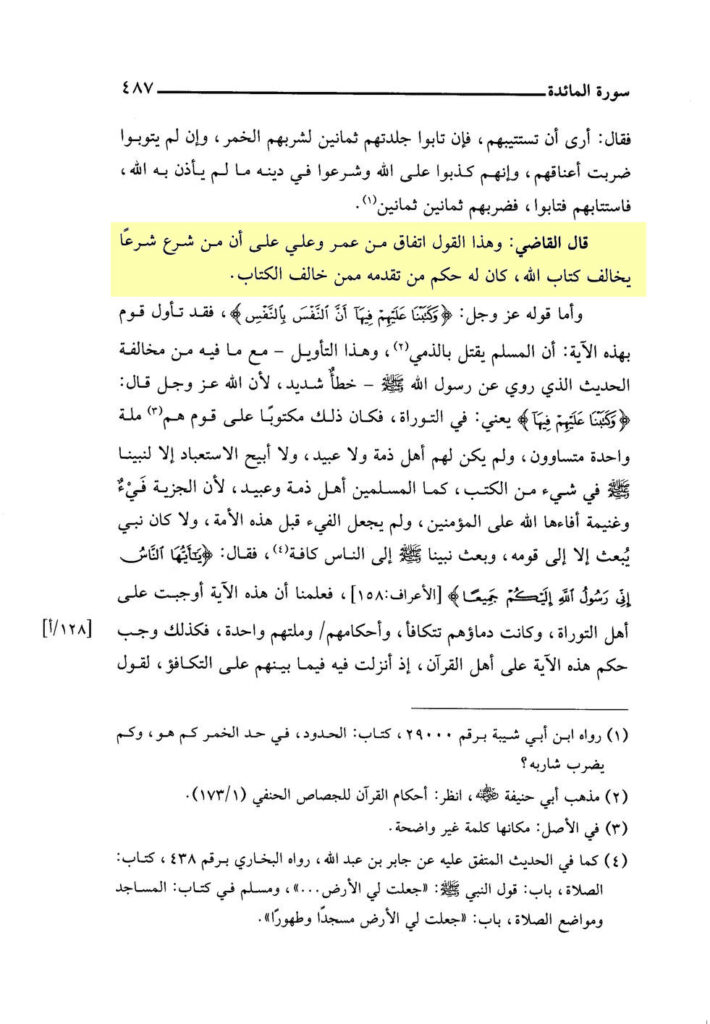
Qāḍī Bakr bin Muḥammad al-Mālikī (d. 344 هـ) narrated the agreement between ‘Umar and ‘Alī regaring the Kufr of one who legislates a law that contradicts the Qur’ān:
al-Qāḍī (likely Qāḍī Isma‘īl bin Isḥaq al-Mālikī) said: And this statement is an agreement between ‘Umar (bin al-Khaṭṭāb) and ‘Alī (bin Abī Ṭālib) that whoever legislates a law (shar’) that contradicts the Book of Allāh would have the ruling of those who preceded him among those who contradicted the Book (Kufr).
‘Umar and ‘Alī, may Allāh be pleased with them, agreed on the Kufr of those who claimed the allowance of Khamr. This was mentioned in a narration just prior to this quote. The Madākhila, who claim that allowing Ḥarām is not Kufr as long as its permissibility is not ascribed to Islām, are fundamentally arguing with Western ‘Aqīda and attempting to stain Islām with it.
They attempt to separate Dīn from the state. However, Dīn is not merely a set of beliefs and practices – it is what is followed. The one who allows Ḥarām in their way of life, whether it is called law, philosophy, religion, or otherwise, is, in all cases, a Kāfir. For he has not submitted to the dīn of Allāh.
These Tawāghīt are far worse than Christians and Jews. For they attack the very foundation upon which the entire Sharī’a and obedience to Allāh are built. They try to promote the absurd notion that changing one’s way of life (Dīn), or even they way of life of millions of people, does not constitute Kufr. Shayṭān has made their words seem good to them
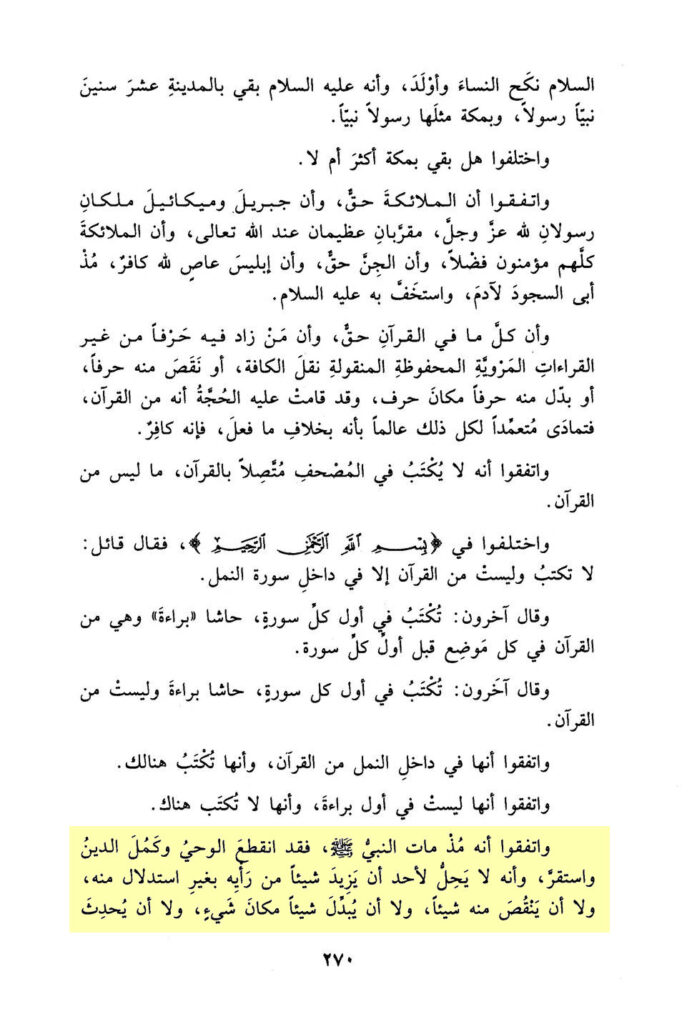
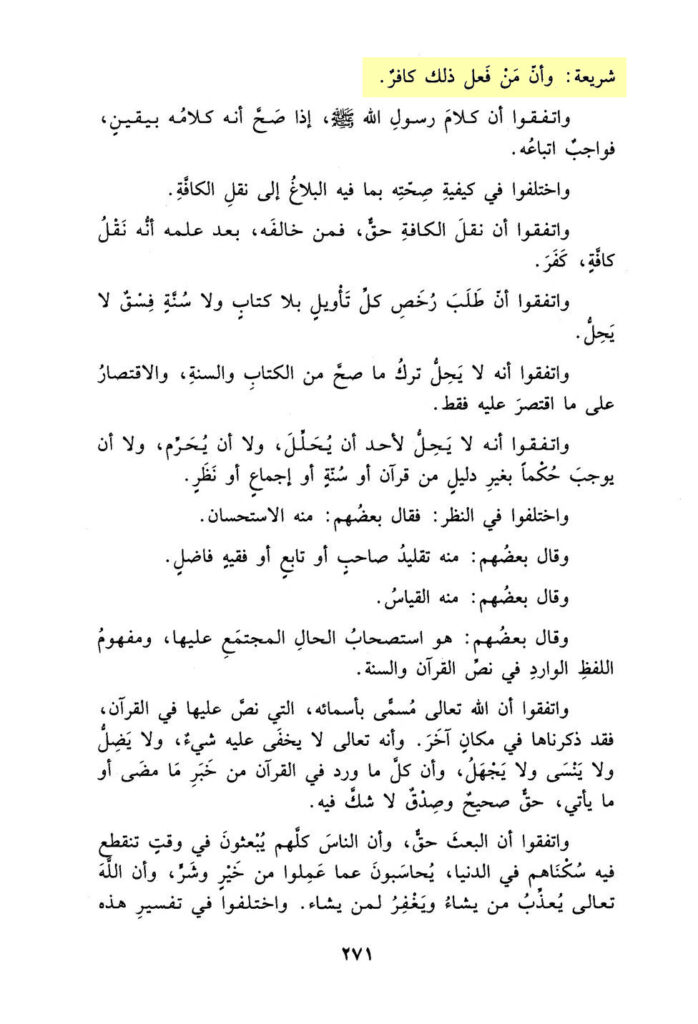
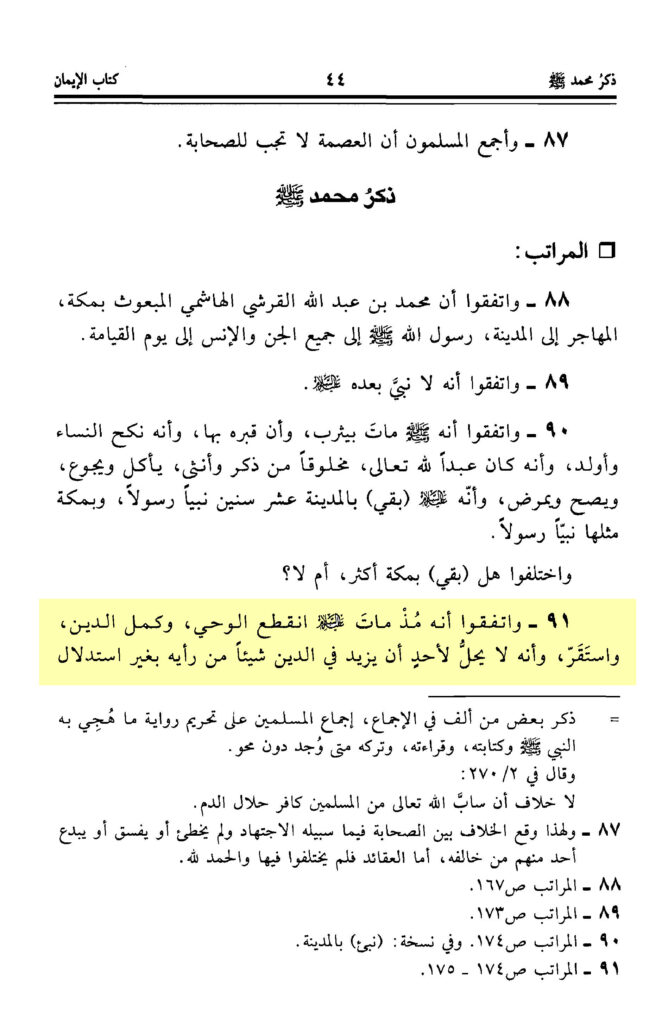
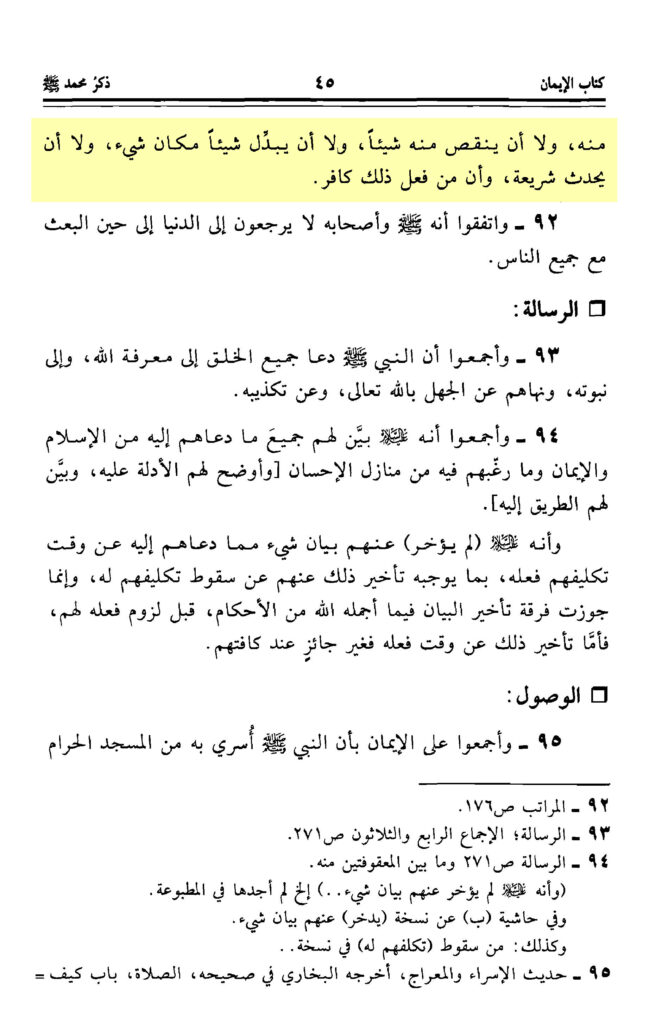
Ibn Ḥazm (d. 456 هـ) transmitted the consensus that whoever brings forth a different legislation than the Sharī’a is a Kāfir:
“And they agreed (ijmā’) that since the Prophet, may Allāh’s peace and blessings be upon him, died, revelation came to an end, and the Dīn became complete and settled. And that no one is allowed to add anything to the Dīn from his opinion without proof from it (the Dīn), nor to subtract anything from it, nor to replace anything (from it) for anything else, nor to bring forth a (different) legislation (than the Sharī’a) and (it is consensus) that whoever does that is a Kāfir“
Ibn Ḥazm mentioned the consensus of all Muslims, that whoever comes with a different legislation than the Sharī’a, is a Kāfir. This statement also refutes the Mushrikūn, who try to deceive people by imposing the fabricated condition of tabdīl on everything without proof. Ibn Ḥazm specifically mentioned tabdīl as something separate from the invention of laws that contradict the Sharī’a, which completely refutes their lie and exposes their kufr.
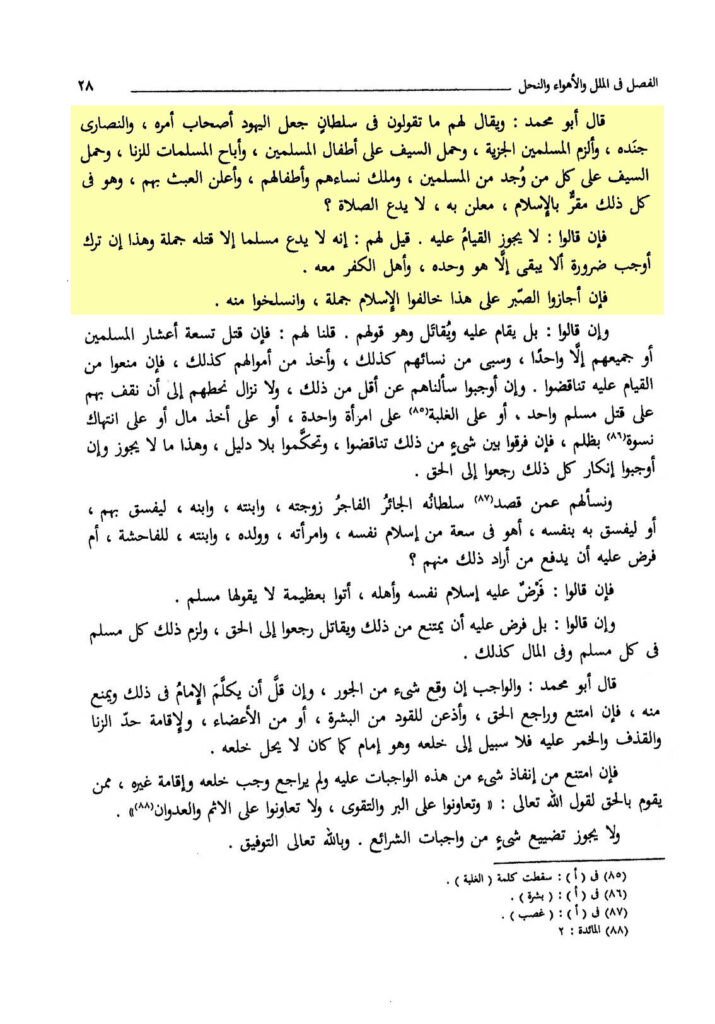
Ibn Ḥazm (d. 456 هـ) explained that absolute obedience to the ruler results in contradicting Islām completely:
“And it is said to them: What do you say about the ruler that made the Jews the associates of his authority, the Christians his soldiers, he imposed the Jizya upon the Muslims, and he raised the sword against the children of the Muslims, and he permitted the Muslim women (to commit) Zinā, and he raised the sword against anyone who he found from the Muslims, and he took possession of their women and their children, and he declared the violation of them. And he is, in all of that, confessing to Islām, proclaiming it, not neglecting the prayer?
And if they said: ‘The rising up against him is not permissible’. It is said to them that he does not let a Muslim, except that he kills him completely. And this, if he is left, made it imperative that none remain, except him alone and the people of Kufr with him. So if they permit the patience despite this, they have contradicted Islām completely and stripped (themselves) of it“
The Mushrikūn nowadays would certainly claim that the ruler of this example would be a Muslim and that obedience to him is supposedly obligatory and that he ought not to be accused of Kufr. This example, among others, makes the implications of their Shirk belief clear and exposes its true conclusion.
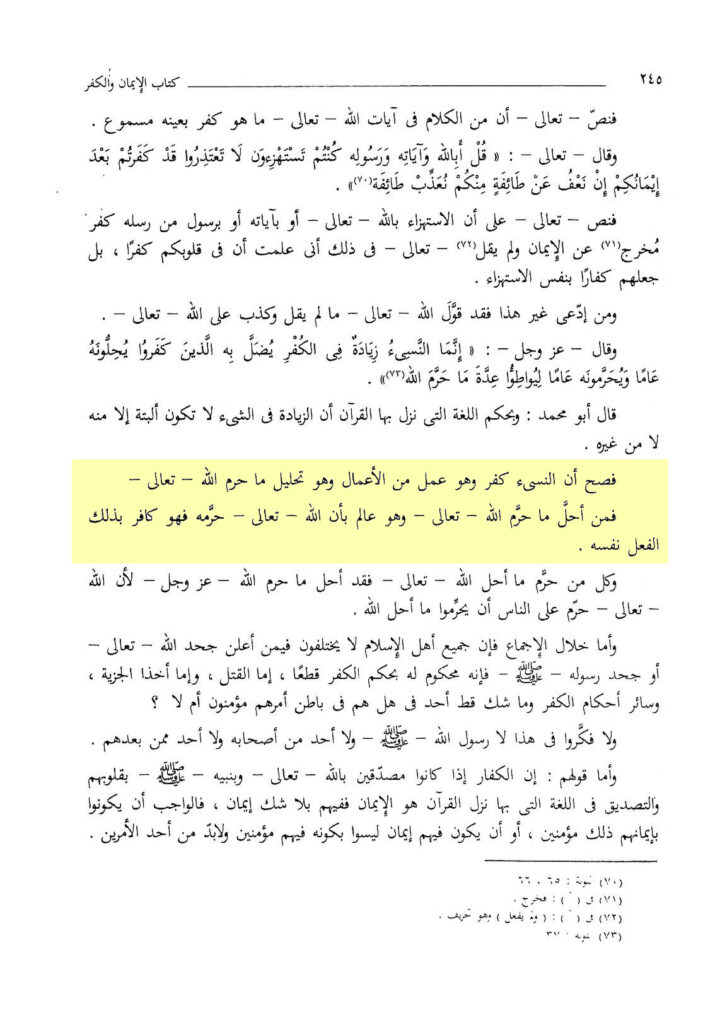
Ibn Ḥazm (d. 456 هـ) explained Istiḥlāl as an action, not merely a belief, and, that the moving of one month in the lunar calendar is Kufr and Istiḥlāl:
“So it is true, that the postponement (of the months) is Kufr. And it is one of the deeds. And it (the postponement) is the allowing of what Allāh, the exalted, made Ḥarām. So whoever allows what Allāh, the exalted, made Ḥarām, knowing that Allāh, the exalted, made it Ḥarām, is a Kāfir by that act itself“
The postponement of months (nasī’) was addressed in Surah 9, verse 37. It was a practice of the Mushrikūn to sometimes change the lunar calendar by establishing another order of months. This action was condemned in the Qur’ān as an increase in Kufr. If this is to be considered an increase in Kufr, then what about the Tawāghīt, who criminalised the Sharī’a and established their own legal judgements that directly contradict what Allāh has made obligatory? They have invented their own Dīn in every matter, be it marriage, commerce and everything else, while imprisoning, killing or persecuting anyone who calls to the Dīn of Islām.
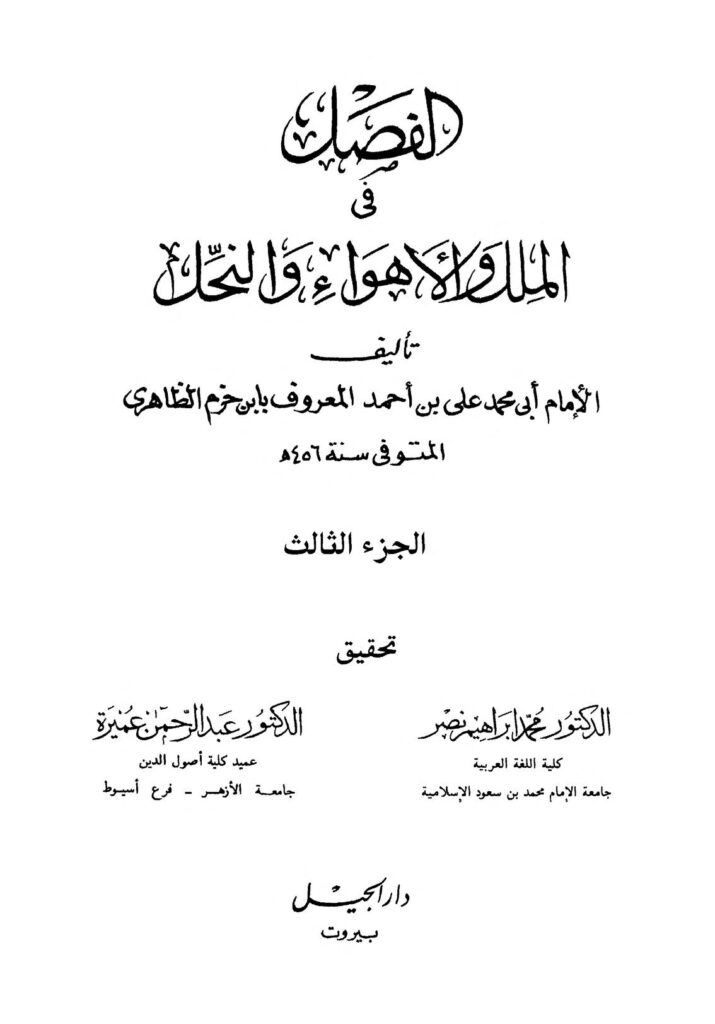
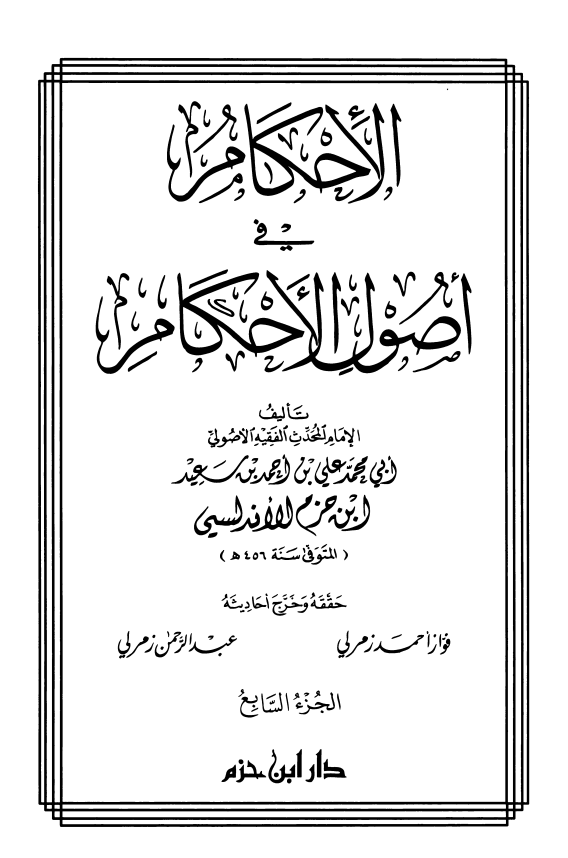
Ibn Ḥazm (d. 456 هـ) said that imposing punishments different to those prescribed in the Sharī’a is Kufr:
And there is no difference between imposing a (different) ḥadd(-punishment) for Khamr (e.g. alcohol) and abolishing the ḥadd(-punishment) of zinā or the increasing in it. Or abolishing a Rak’a (prayer unit) from the Dhuhr (prayer) or addition in it. Or imposing a prayer other than the prescribed prayers. Or imposing a supposed (allowed) limit in consuming Ribā (e.g. usury). And all this is (major) Kufr from those who authorized it.
The context of his statement makes it is clear, that he is referring to major Kufr and that the authorization and commandment, today called legislation, of those punishments that contradict the Sharī’a is major Kufr.
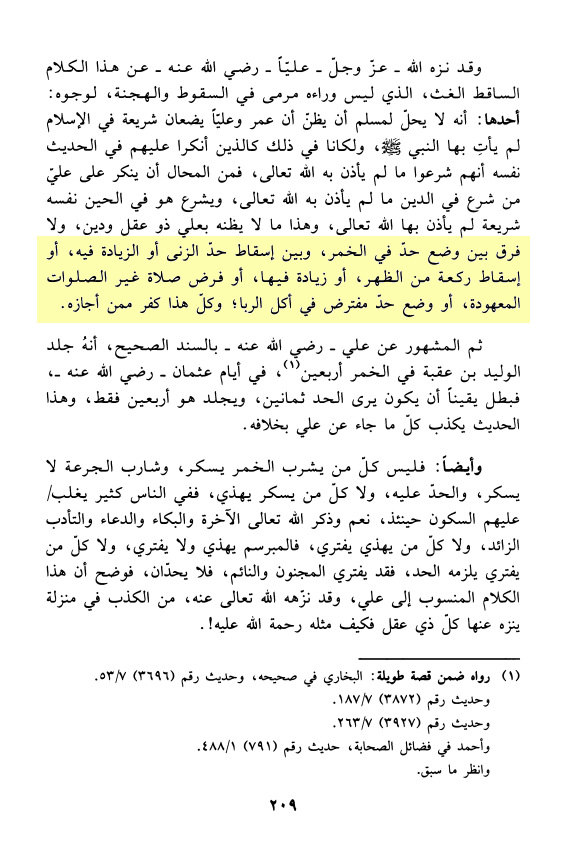
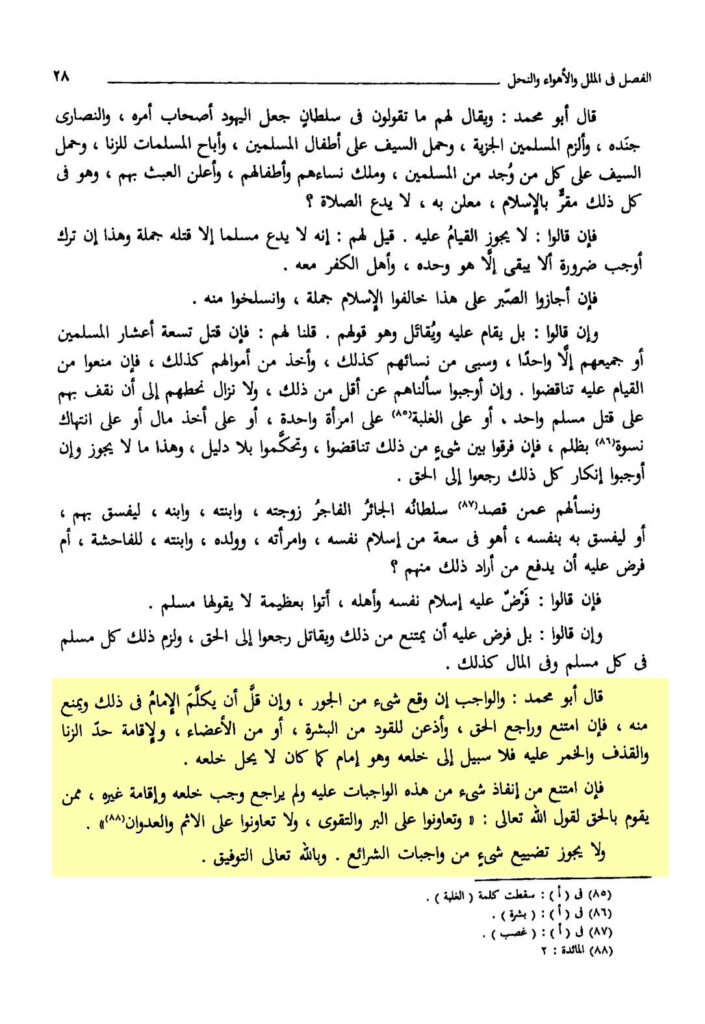
Ibn Ḥazm (d. 456 هـ) said that the legitimacy of the ruler is dependent on the establishment of the Sharī’a:
“And the obligation is that, if something of injustice occurs, even if it is small, to speak to the Imām about that and prevent it. So if he refrains and returns to the truth and submits to the retaliation of the skin or the limbs and to the establishment of the Ḥadd (punishment) of Zinā, Qadhf (wrongful accusation with Zinā) and Khamr upon him, then there is no way to his removal (from office) and he is an Imām, just as his removal (from office) was not Ḥalāl.
So if he declines carrying out any of these obligations upon him and does not return (to Islām), his removal (from office) and the establishment of someone other than him, from those who uphold the truth (Sharī’a) is obligatory, due to His, the Exalted, statement:
«And cooperate with one another in righteousness and Taqwā and do not cooperate with one another in sin and transgression» [5:2]
And neglect of any of the obligations of the laws (of the Sharī’a) is not permissible. And through Allāh, the Exalted, is the success”
Ibn Ḥazm (d. 456 هـ) said regarding the patience with the ruler:
“As for his command, may Allāh’s peace and blessings be upon him, with patience during the seizure of the property and the striking of the back, then that is only, without a doubt, if the Imām takes possession of it by means of truth (in accordance with the Sharī’a). And this is where there is no doubt in it, that he imposed the patience with him (the Imām) on us”
If the patience with the ruler is contingent on his actions being in accordance with the Sharī’a, and if they are not, the obligation of enjoining good and forbidding evil arises, then the notion proposed by certain Mushrikūn to be patient with the ruler, no matter what he does and what limits of the Sharī’a he oversteps, is completely disproven by conclusion.
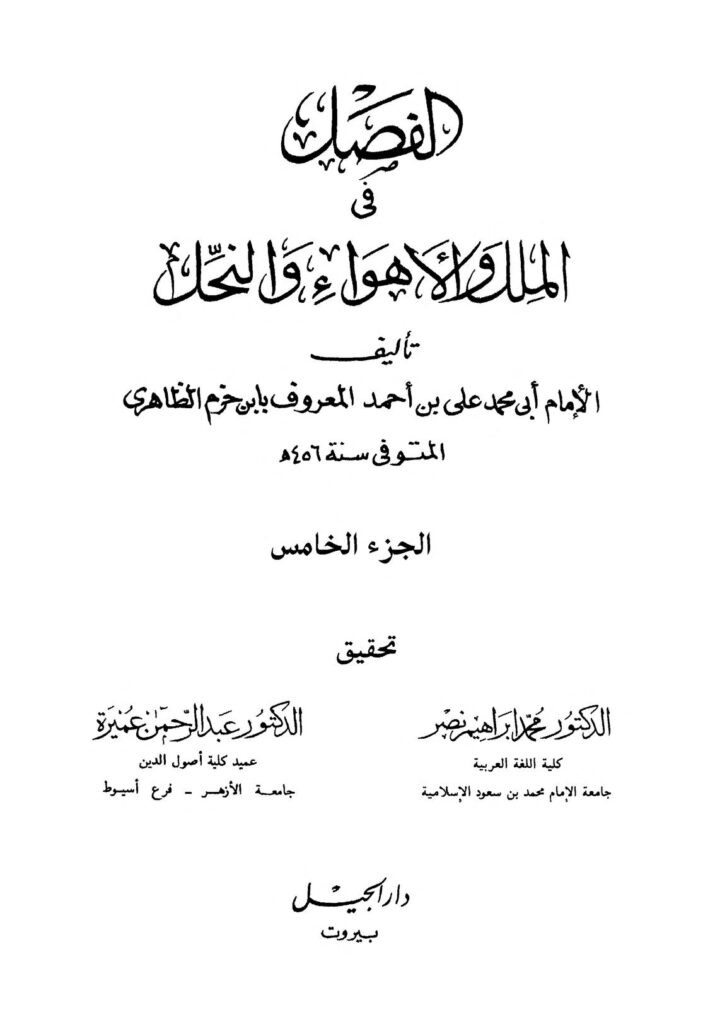
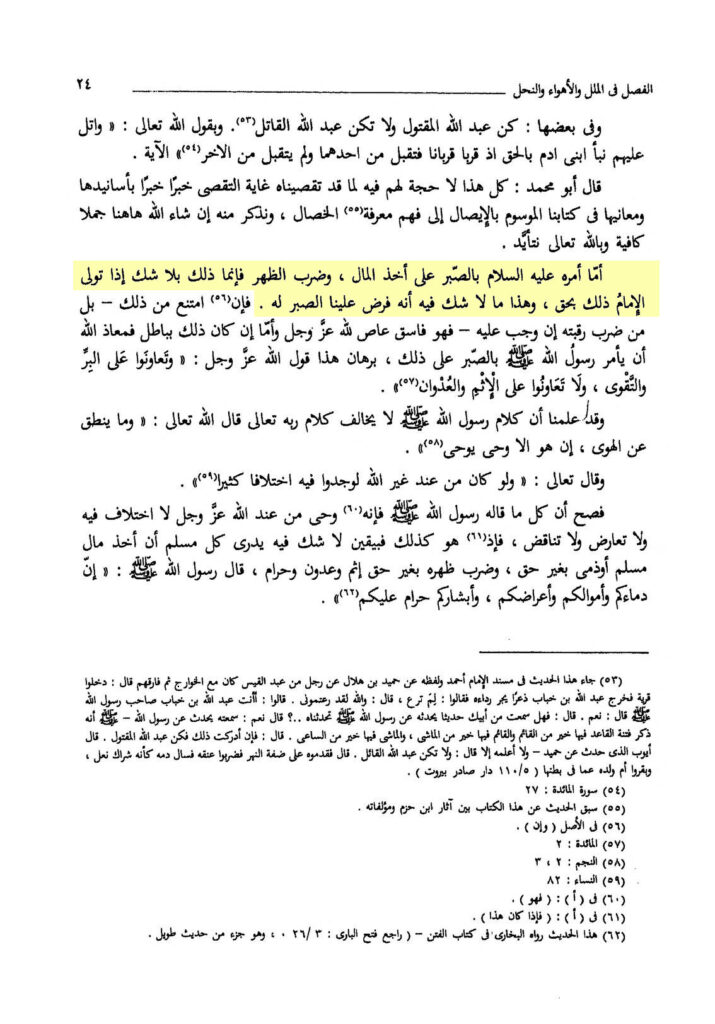
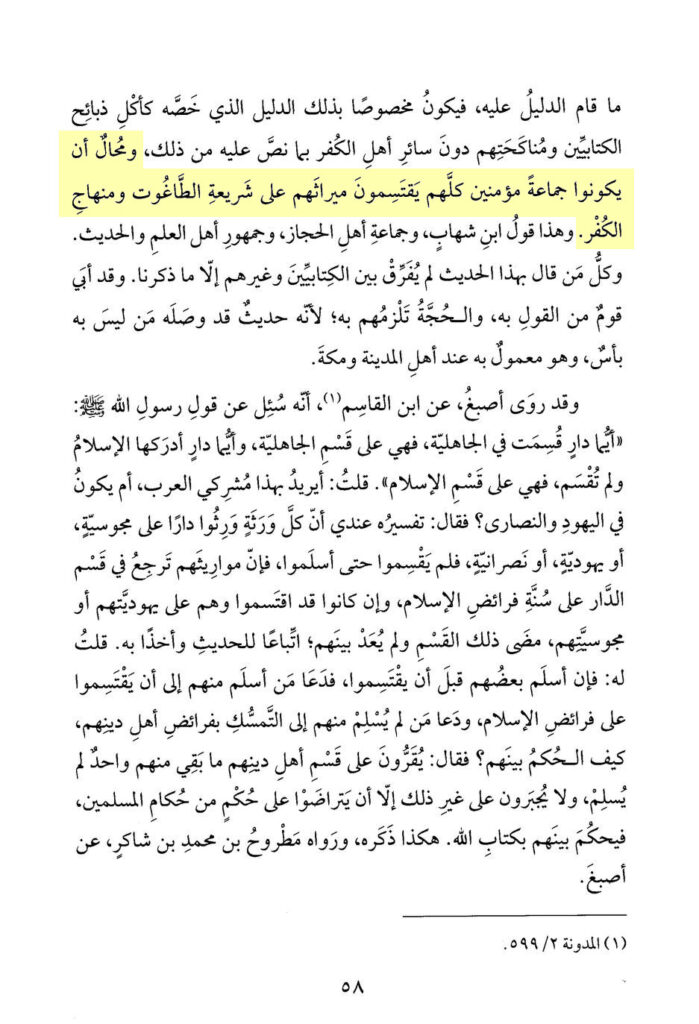
Imām Ibn ʿAbdulbarr al-Mālikī (d. 463 هـ) described laws outside the sharī’a as the laws of the tāghūt:
“And it is impossible that they are a group of believers who all divide their inheritance according to the law of the tāghūt and the way of kufr“
It is narrated from Imām Mālik on this matter that if an idolater or a majūsī accepts Islām and they have an inheritance from the jāhilīyya that has not been divided, then it is divided according to the sharī’a of Islam. However, if they were ahl al-kitāb and the heirs did not divide the inheritance until they became Muslims, then they divide the inheritance according to the previous legislation. There is a difference of opinion on whether Mālik made a distinction between the idolaters of the Arabs and the majūsīs on the one side and the Ahl al-Kitāb on the other. The principle of the aforementioned opinion is that the inheritance is due at the corresponding time, and each heir has what is due to him at that time.
This principle is also transmitted from ʿAlī bin Abī Ṭālib, Saʿīd bin al-Musayyib, Ibrāhīm an-Nakhaʿī, Sulaymān bin Yasār, az-Zuhrī, ash-Shāfiʿi and the majority of scholars. They said: Anyone who converts to Islām after death or is freed has no claim to inheritance, because the inheritance was already determined at the time of the deceased’s death. Ibn ʿAbdulbarr did not follow this opinion, which is why he made this statement. And his statement refutes the Mushrikūn, because he described the laws that contradict Islām as the law of the Tāghūt. And that is exactly our statement.
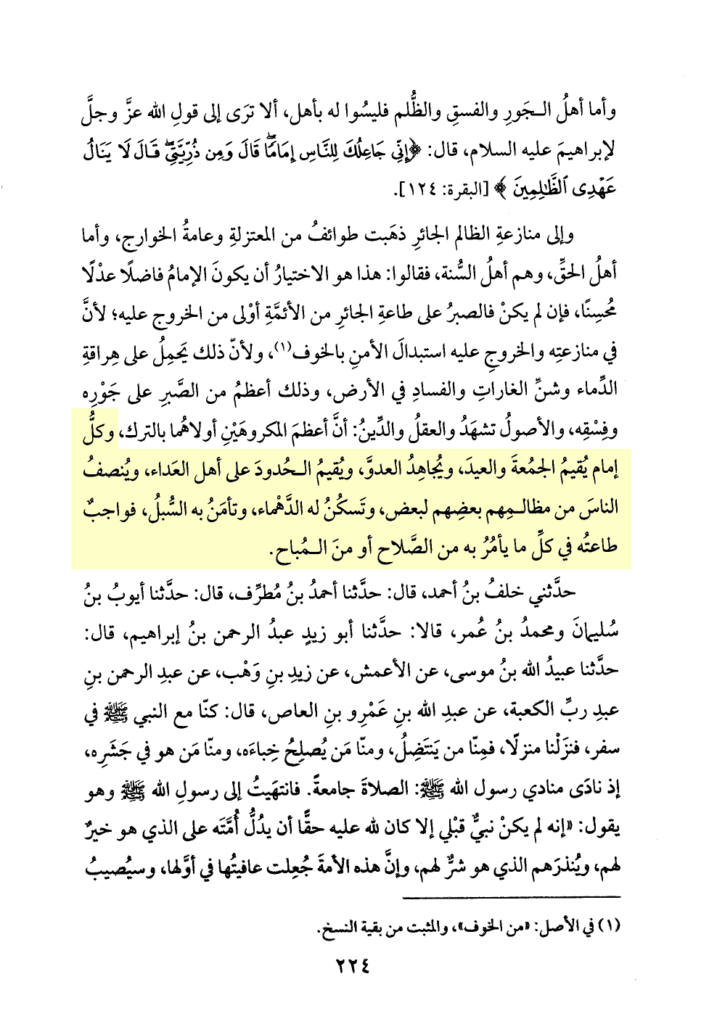
Imām Ibn ‘Abdulbarr al-Mālikī (d. 463 هـ) stated that obedience to the ruler is contingent upon his establishment of the Sharīʿa:
وكلُّ إمام يُقيمُ الجمُعةَ والعيدَ
And every Imām who establishes the Friday prayer and the ʿĪd prayer,
ويُجاهِدُ العدوَّ، ويُقيمُ الحُدودَ على أهل العَداء
and fights the enemy, and erects the Ḥudūd against the people of hostility,
ويُنصفُ الناسَ من مظالمِهم بعضِهم لبعض
and gives justice (according to the Sharīʿa) to the people regarding their injustices (of) some of them against others,
وتَسكُنُ له الدَّهْماء، وتأمَنُ به السُّبلُ
and the populace trust him, and the roads are safe by him,
فواجبٌ طاعتُه في كلِّ ما يأمُرُ به من الصَّلاح أو منَ المُباح
then obedience to him is obligatory in everything he commands of what is righteous or of what is permissible (Mubāḥ).
Imām Ibn al-Qaṭṭān al-Mālikī (d. 628 هـ) transmitted the consensus that whoever brings forth a different legislation than the Sharī’a is a Kāfir:
“And they agreed (ijmā’) that since he (the Prophet), peace be upon him, died, revelation came to an end, and the Dīn became complete and settled. And no one is allowed to add anything to the Dīn from his opinion without proof from it (the Dīn), nor to subtract anything from it, nor to replace anything (from it) for anything else, nor to bring forth a (different) legislation (than the Sharī’a) and (it is consensus) that whoever does that is a Kāfir“
Imām Ibn al-Qaṭṭān mentioned the consensus of all Muslims, that whoever comes with a different legislation than the Sharī’a, is a Kāfir. This statement also refutes the Mushrikūn, who try to deceive people by imposing the fabricated condition of tabdīl on everything without proof. Ibn al-Qaṭṭān specifically mentioned tabdīl as something separate from the invention of laws that contradict the Sharī’a, which completely refutes their lie and exposes their kufr.
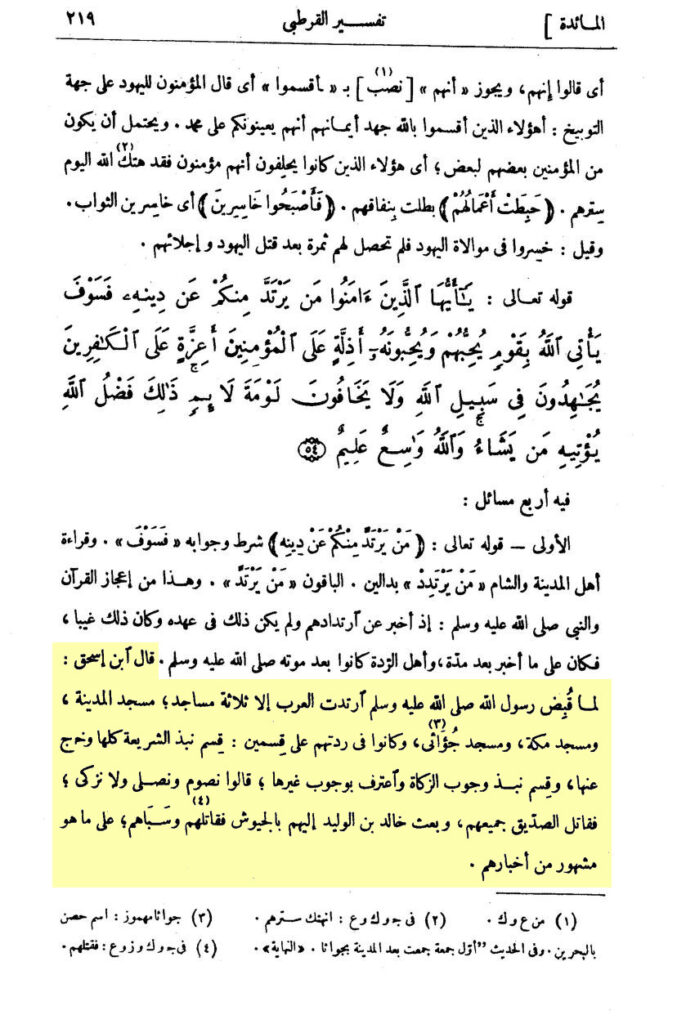
Imām al-Qurṭubī al-Mālikī al-Ash’arī (d. 671 هـ) mentioned that Abū Bakr aṣ-Ṣiddīq fought the Murtaddūn for not giving the Zakāh:
Ibn Isḥāq said: When the Messenger of Allāh, may Allāh’s peace and blessings be upon him, was taken (from the Dunyā), the Arabs apostatized (became Kuffār) except for three mosques: the mosque of Madīnah, the mosque of Makkah and the mosque of Juāthā. And they were in their apostasy upon two groups: A group that abandoned all of the Sharī’a and deviated from it. And a group that abandoned the obligation of the Zakāh and acknowledged the obligation of other than it. They said: “We fast and pray, but we do not give Zakāh”. So the veracious (Abū Bakr aṣ-Ṣiddīq) fought all of them and he sent Khālid bin al-Walīd to them with the troops. So he fought them and took them as prisoners according to what is well-known from their reports.
So if Abū Bakr considered them Murtaddūn for not giving the Zakāh, what would he consider the people of the Middle East and alike for abandoning the Sharī’a and fighting against it?
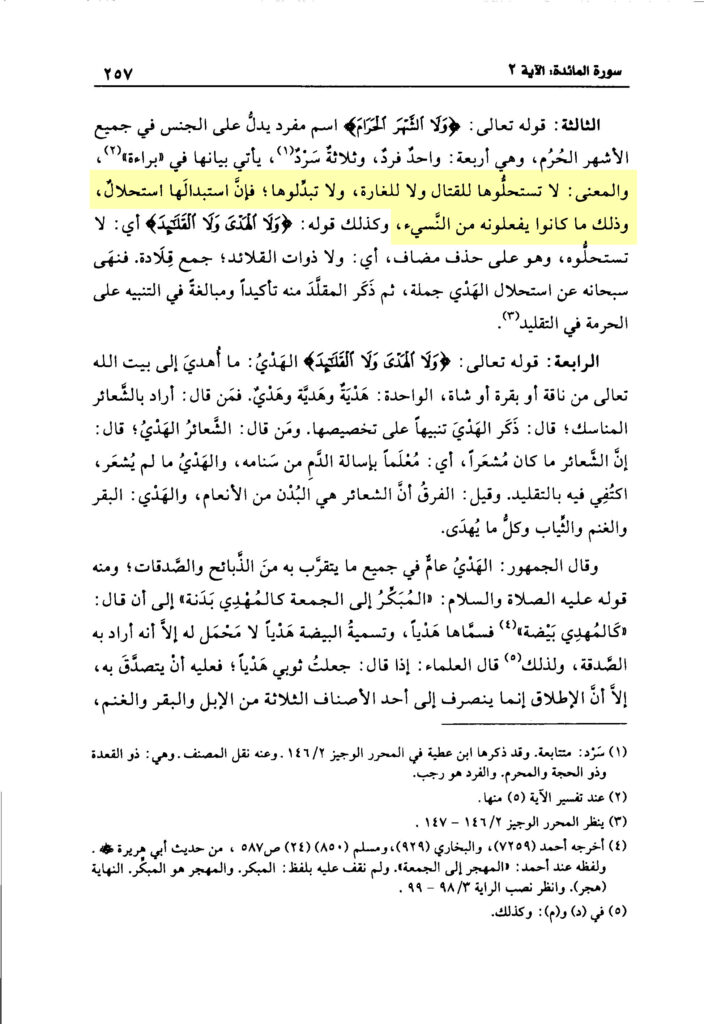
Imām al-Qurṭubī (d. 671 هـ) explained Istiḥlāl (declaring something permissible) as an action, not merely a belief, and stated that moving a month of the Hijrī calendar is Kufr and Istiḥlāl:
“And the meaning is: Do not regard them as Ḥalāl for battle, nor for raid, and do not change them, for indeed, their change is their Istiḥlāl (declaring as permissible). And this is what they (the Mushrikūn) used to do with the Nasi’ (postponing of the months)”
The postponing of months (nasī’) was addressed in Surah 9, verse 37. It was a practice of the Mushrikūn to add a lunar month. In doing so, they changed the lunar calendar in some years by establishing something different. This action was condemned in the Qurʾān as an increase in kufr.
So how about the Tawāghīt nowadays, who criminalize the Sharī’a and establish their own laws that directly contradict what Allāh has established, and have invented their own Dīn in everything that contradicts the Dīn of Islām, while imprisoning, killing, or persecuting anyone who calls to the Dīn of Islām?
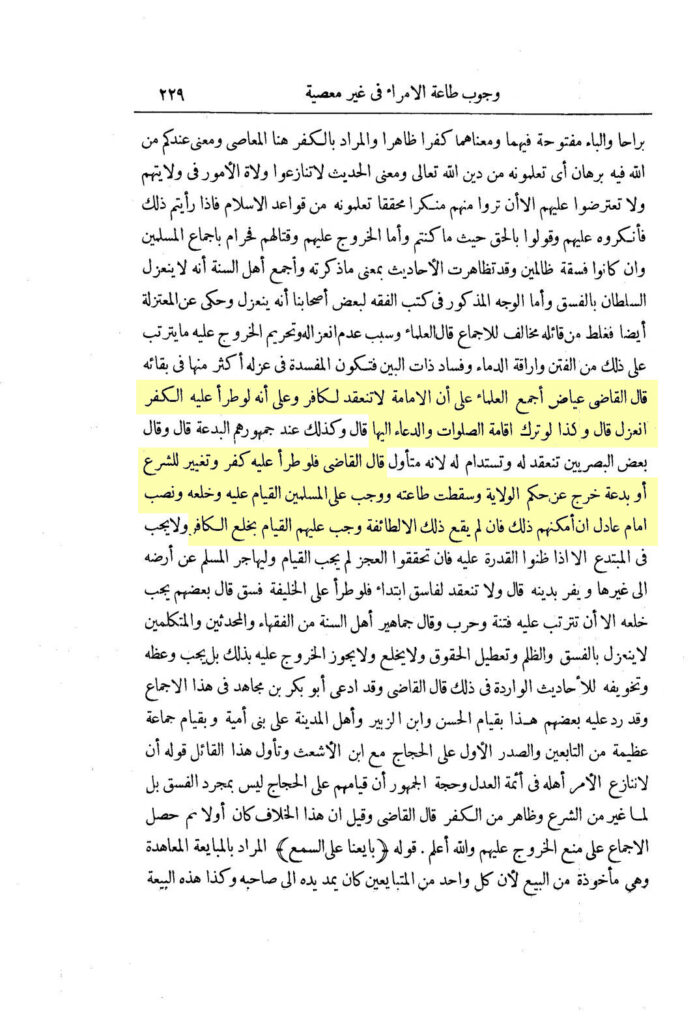
Imām an-Nawawī (d. 676 هـ) mentioned from Imām al-Qāḍī ‘Iyāḍ al-Mālikī (d. 544 هـ) the consensus that the Imāma can never be established for a Kāfir:
“al-Qāḍī ‘Iyāḍ (al-Mālikī) said: The scholars unanimously agreed (ijmā’) that the Imāma (leadership) is not established for a Kāfir and that if Kufr were to befall him, he would be removed (from office). He said: And likewise, if he has left the performance of the prayers and the calling to them. (…) al-Qāḍī ‘Iyāḍ (al-Mālikī) said: So if Kufr or a change in the law (shar’) or an innovation (in the law, shar’) were to occur to him, he has deviated from the rule of government (wilāya) and his obedience (ṭā’a to him) became invalid. And the rising up against him, his removal (from office) and the appointment of a just Imām are obligatory upon the Muslims, if that is possible for them. And if that does not take place except by means of a group, (then) the rising up is obligatory upon them for the removal of the Kāfir (from office)”
The innovation mentioned by Qāḍī ‘Iyāḍ al-Mālikī does not refer to a mere illegitimate innovation in Shar’ī-matters, which would be Ḥarām. For it has been transmitted from the classical scholars that, according to the consensus of Muslims, Khurūj is not Ḥalāl in the case of Ḥarām. And Imām an-Nawawī also stated at this point that no other opinion is accepted in this matter and that anything else contradicts the classical scholars.
As should be clear, our scholars would not have expected any obedience to today’s rulers in the Middle East – quite the contrary, in fact. As Imām al-Qāḍī ‘Iyāḍ al-Mālikī mentioned, if a change is made that contradicts the Sharī’a – even if only in a single matter – all obedience becomes invalid and such a rule is completely illegitimate under Islāmic law. There is no obedience to a ruler in disobedience to Allāh.
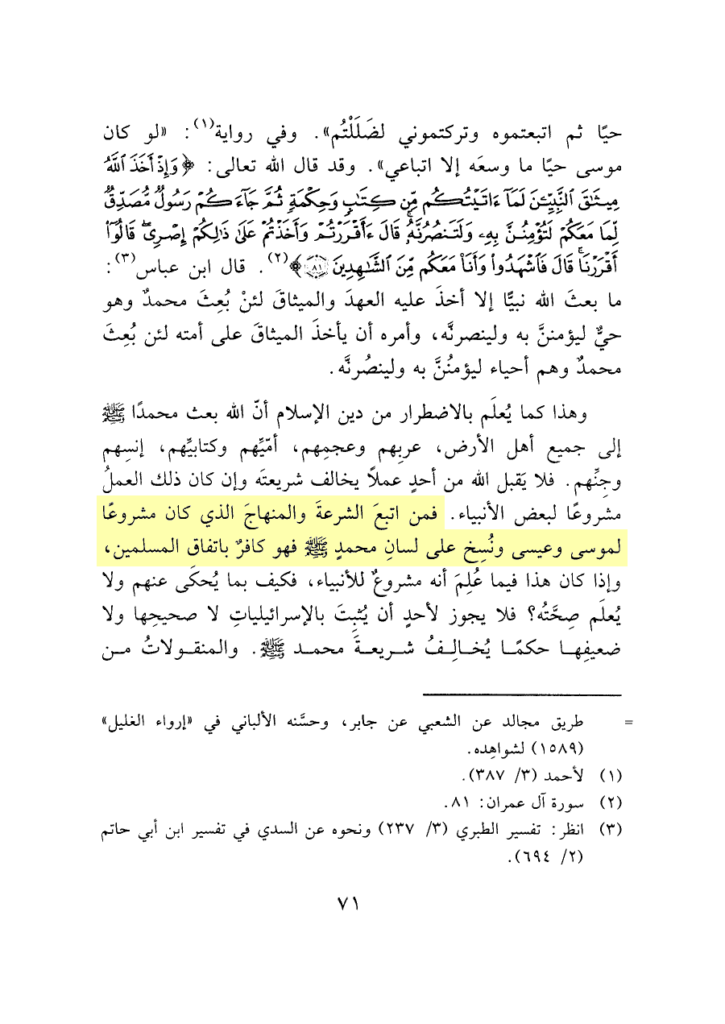
Ibn Taymīyya (d. 728 هـ) said that whoever follows something other than our Sharī’a is a Kāfir by consensus:
Whoever follows the legislation (Sharī’a) and method which was legislated for Mūsā and ‘Īsā and abrogated by the tongue of Muḥammad, may Allāh’s peace and blessings be upon him, is a Kāfir by the agreement (consensus) of the Muslims.
If somebody is a Kāfir by following the Sharī’a of those who came before us, then those who follow man-made laws, in contradiction to our Sharī’a, are even worse in their Kufr. Ibn Taymīyya agreed with the Ahl as-Sunna on this matter and was quoted solely for this reason.
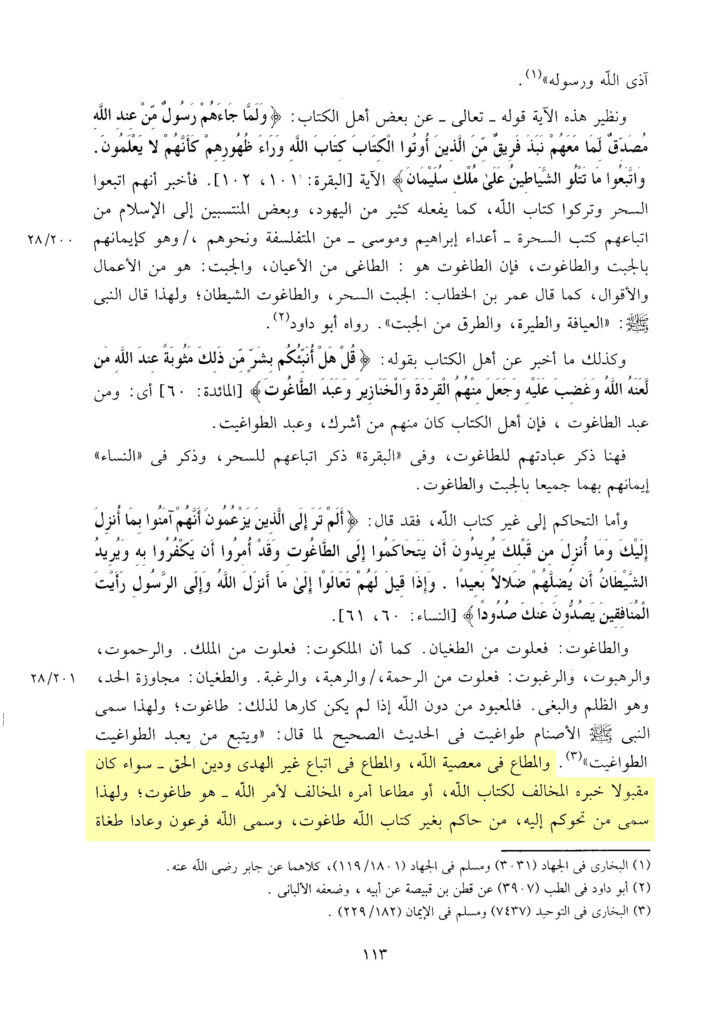
Ibn Taymīyya (d. 728 هـ) said that those whose contradiction of the Book of Allāh is followed are called Tawāghīt/Tāghūt:
“And the one obeyed in disobedience to Allāh, and the one obeyed in following of (something) other than the guidance (of Islām), and the Dīn of the truth – it is the same whether his word, the contradicting to the Book of Allāh, is accepted, or his command, the contradicting to the command of Allāh, is obeyed – he is a Tāghūt. And because of this, from whomever judgement is sought, who ruled by other than the Book of Allāh, was named a Tāghūt. And Allāh named Fir’awn and ‘Ād Tuġāh”
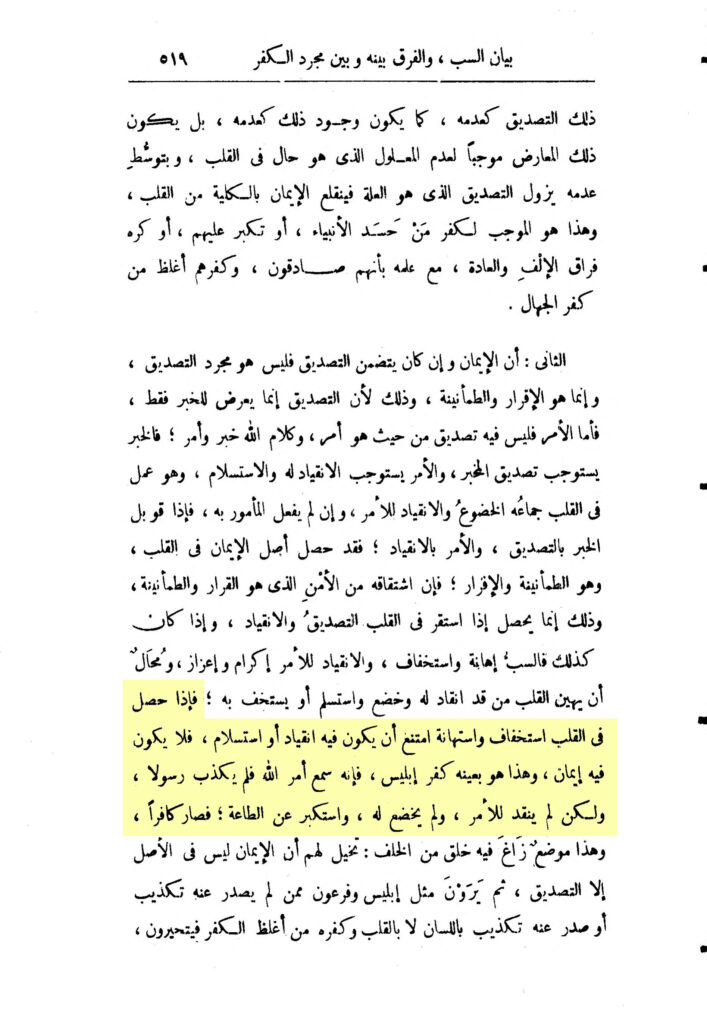
Ibn Taymīyya (d. 728 هـ) said that whoever does not submit to the command of Allāh is on the same level of Kufr as Iblīs:
“So if disregard and indifference occurred in the heart, it became impossible that submission (inqiyād) or surrender (istislām) were in it. So there is no Īmān in it (the heart). And this is exactly the same (as) the Kufr of Iblīs, for truly, he heard the command of Allāh to him, and he did not accuse any messenger of lying. However, he did not submit to the command, and he did not surrender to it, and he displayed arrogance regarding obedience, so he became a Kāfir“
To be a Muslim, one must submit and surrender to the Sharī’a. The Tawāghīt, however, have followed Iblīs, for they have not denied that the Sharī’a was revealed, nor have they claimed that the Sharī’a is a different Sharī’a, attributing other rulings to Islām. Instead, they refused to submit and surrender to the Sharī’a. They have behaved arrogantly towards obedience and are therefore Kuffār by consensus.
Whoever excuses the Tawāghīt in their Kufr has excused Iblīs in his Kufr. And whoever doubts the Kufr of either of them is a Kāfir. Ibn Taymīyya agreed with the Ahl as-Sunna on this matter and was quoted solely for this reason.
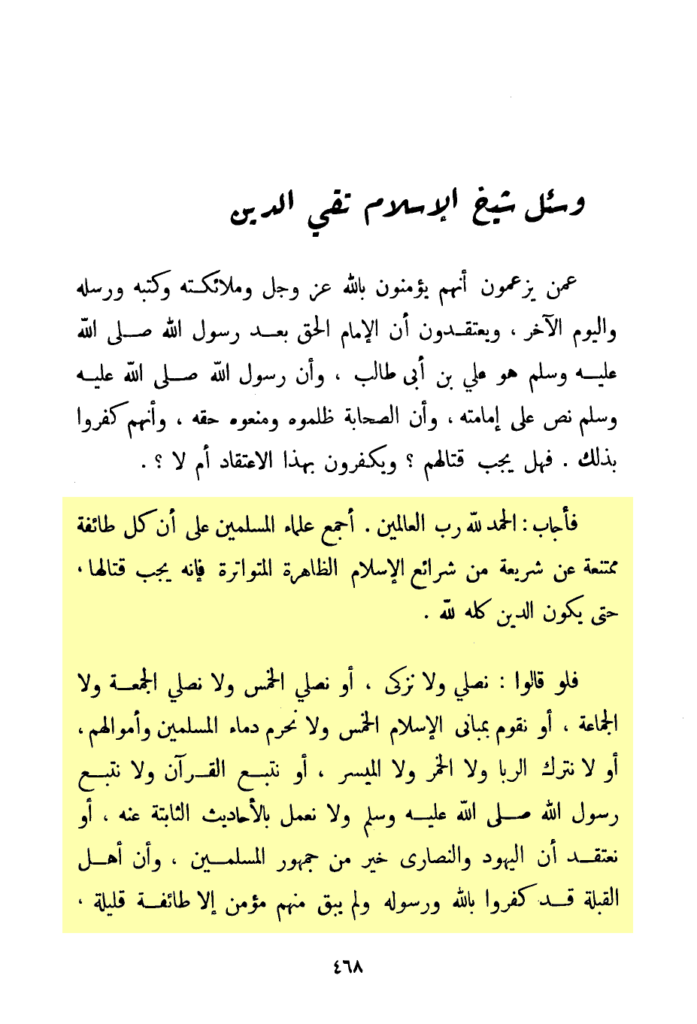
Ibn Taymīyya (d. 728 هـ) said that any group refusing to oblige by any law from the clear, mass-transmitted laws of Islām are Kuffār:
Praise be to Allāh, Lord of the Worlds. The scholars of the Muslims unanimously agreed (ijmā’) that any group refusing (ṭā’ifah mumtani’ah) any law from the clear, mass-transmitted (mutawātir) laws of Islām must be fought until the Dīn is entirely for Allāh.
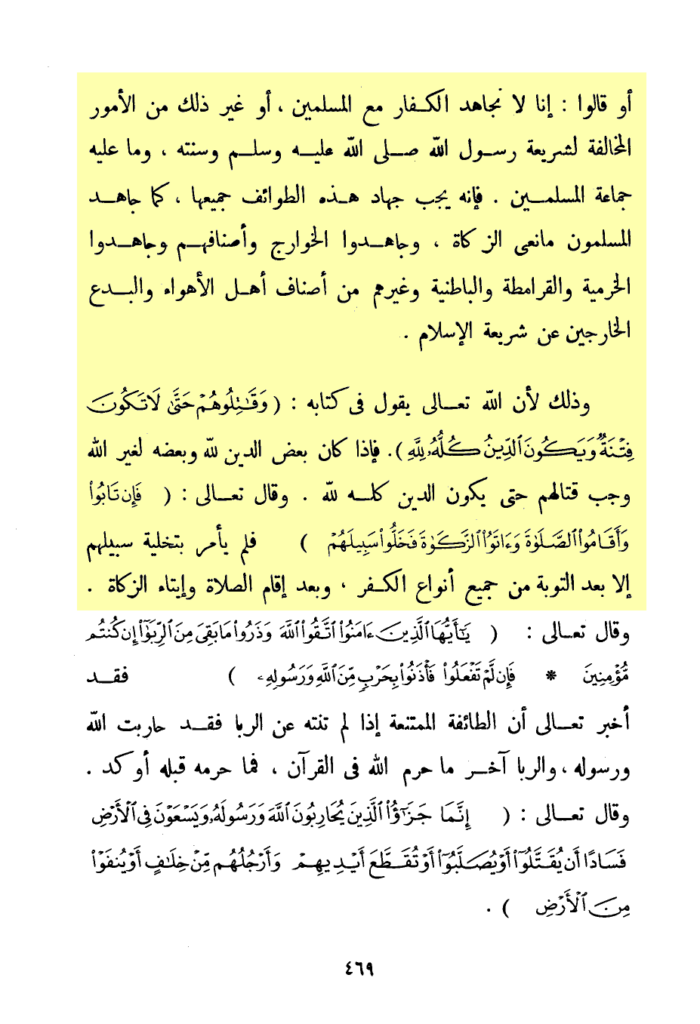
So if they say: “We pray but do not give Zakāh”, or “We pray the five (daily prayers), but do not pray the Friday (prayer) nor the congregational (prayer)”, or “We establish the five foundations (pillars) of Islām, but we do not forbid the blood of the Muslims and their wealth”, or “We do not leave Ribā (e.g. usury), nor Khamr (e.g. alcohol), nor Maysir (e.g. gambling)”, or “We follow the Qur’ān, but we do not follow the Messenger of Allāh – may Allāh’s peace and blessings be upon him – nor do we act upon the established Aḥādīth from him”, or “We believe that the Jews and Christians are better than the majority of Muslims, and that the people of the Qibla became Kuffār in Allāh and His Messenger, and none of them remained a believer except a small group (Khawārij doing Takfīr over sins)”, or they say: “Indeed, we will not fight the Kuffār together with the Muslims”, or other than that from the matters that violate the Sharī’a of the Messenger of Allāh, may Allāh’s peace and blessings be upon him, and his Sunna and that which the community of Muslims is upon.
Then the fighting against all of these groups is obligatory, just as the Muslims fought the withholders of the Zakāh, and fought the Khawārij and their types. And fought the Khurramīya, Qarāmiṭa, Bāṭinīya, and other besides them, from the categories of the people of desires and innovations, who deviate from the Sharī’a of Islām. And this is because Allāh, the Exalted, says in His book: «And fight them until there is no more Fitna and the Dīn is entirely for Allāh» [8:39]. So if some of the Dīn is for Allāh and some of it is for other than Allāh, fighting them is obligatory until the Dīn is entirely for Allāh. And He, the Exalted, says: «But if they repent, and establish the prayer, and give the Zakāh, then leave their way» [9:5]. He did not command the leaving of their way, except after Tawba from all types of Kufr and after the establishment of the prayer and the giving of the Zakāh.
The aforementioned concept of fighting refers to a normative obligation of an established state to go to war. While something may be deemed obligatory by law, there can be a discrepancy between the normative obligation and its practical implementation. This has historically been the case throughout much of Islāmic history, without suspending the general obligation. The foreign policy goal of spreading one’s own belief is not exclusive to Islām. Rather, it is prominently found in contemporary policies, such as the U.S. foreign policy of spreading democracy, the Soviet Union’s efforts to spread communism, and similar ideologies. Ibn Taymīyya agreed with the Ahl as-Sunna on this matter and was quoted solely for this reason.
Ibn Taymīyya (d. 728 هـ) mentioned the laws that contradict Islām as the greatest contradiction to the Dīn of Islām:
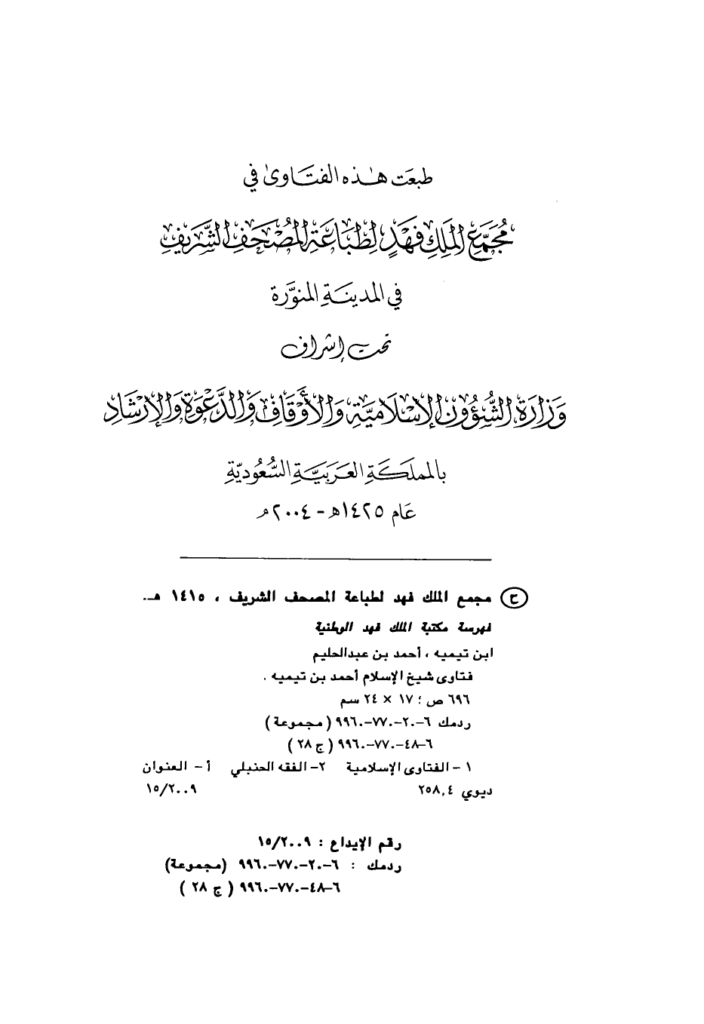
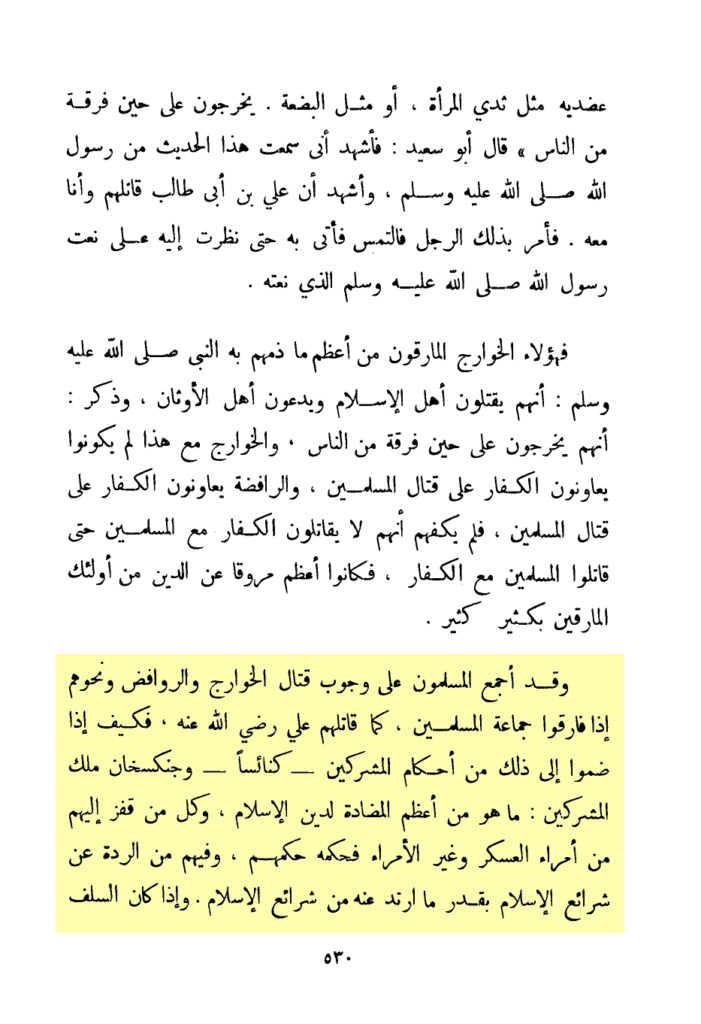
The Muslims unanimously agreed (Ijmā’) on the obligation of fighting the Khawārij and Rawāfiḍ and the like, if they separate from the community of the Muslims. Just as ‘Alī, may Allāh be pleased with him, fought them. So how about if they incorporate to that from the laws of the Mushrikūn – (laws of the) churches – and (the laws of) Genghis Khan, the king of the Mushrikūn: which is among the greatest (forms of) opposition to the Dīn of Islām. And everyone who jumped to them (switched sides) among the commanders of the army and other commanders, then his judgement is their judgement (i.e. Mushrik). And among them is apostasy from the laws of Islām, to the same extent to which he apostatized from the laws of Islām.
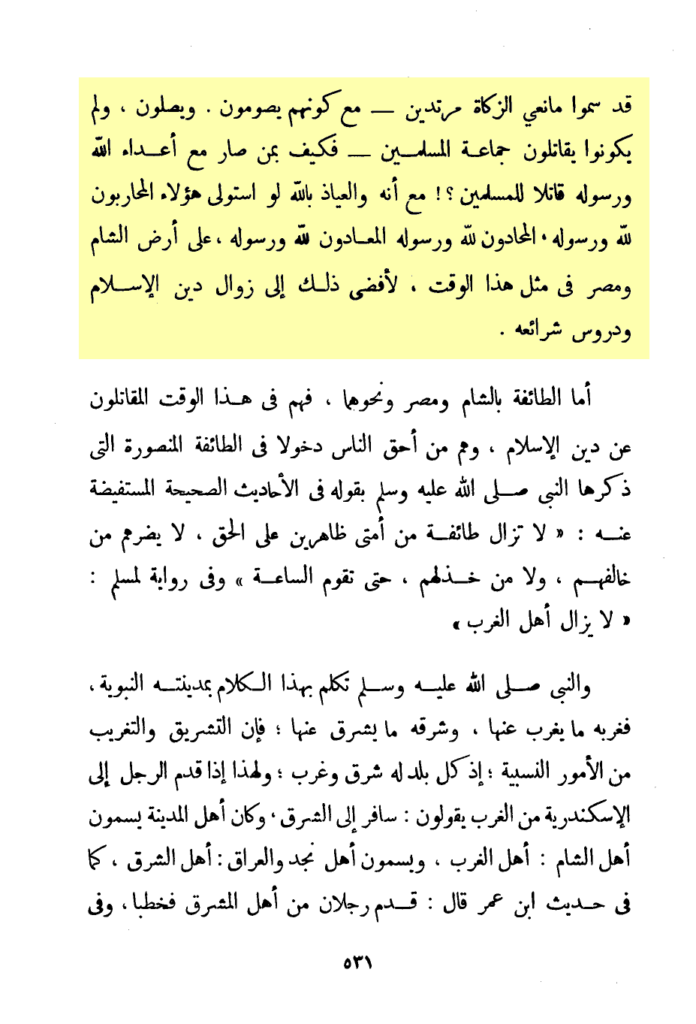
And if the Salaf designated those who withheld the Zakāh as apostates (murtaddīn) – despite their fasting and praying, and (despite that) they were not fighting the community of the Muslims – then what about one who came to be fighting together with the enemies of Allāh and His Messenger against the Muslims?! Simultaneously, and refuge is sought through Allāh, if these (people) who wage war against Allāh and His Messenger, who oppose Allāh and His Messenger, and who are hostile to Allāh and His Messenger were to take power over the lands of Shām and Egypt at such a time, it would certainly lead to the disappearance of the Dīn of Islām and the extinction of its laws.
If Ibn Taymīyya described those who fight with them as Mushrikūn, mentioning that them taking over power would lead to the disappearance of the Sharī’a, then this also implies the Kufr of those who contradict the laws of the Sharī’a. Those who establish Shirk laws as supreme and do not subjugate themselves to the boundaries set by Allāh. Ibn Taymīyya agreed with the Ahl as-Sunna on this matter and was quoted solely for this reason.
Ibn Taymīyya (d. 728 هـ) said that whoever calls to be obeyed instead of Allāh is calling for Shirk:
Whoever among the obeyed – among the leaders, the scholars and the Sheikhs – was following the Messenger, may Allāh’s peace and blessings be upon him, commanded what he (the Messenger) commanded, called to it, and loved whoever called to what he called to. For indeed Allāh loves that. So he loves what Allāh loves, because his aim is the worship of Allāh alone and that the Dīn be for Allāh (alone). And whoever (the Tawāghīt) hates that there be a counterpart to him calls to that. Then this one wants him to be the one obeyed and worshipped, and for him is a share of the condition of Fir’awn and his like. So whoever wants to be obeyed instead of Allāh, then this is the condition of Fir’awn. And whoever wants to be obeyed alongside Allāh, then this (person) wants from the people that they take others besides Allāh as equals (Shirk). They love them as they should love Allāh. And Allāh, Glorified and Exalted be He, commanded that none be worshipped except Him. And that the Dīn be for none except for Him. And that the loyalty and the enmity be for His sake. And he relies on none except Him, and seeks help from none except through Him.
Ibn Taymīyya agreed with the Ahl as-Sunna on this matter and was quoted solely for this reason.
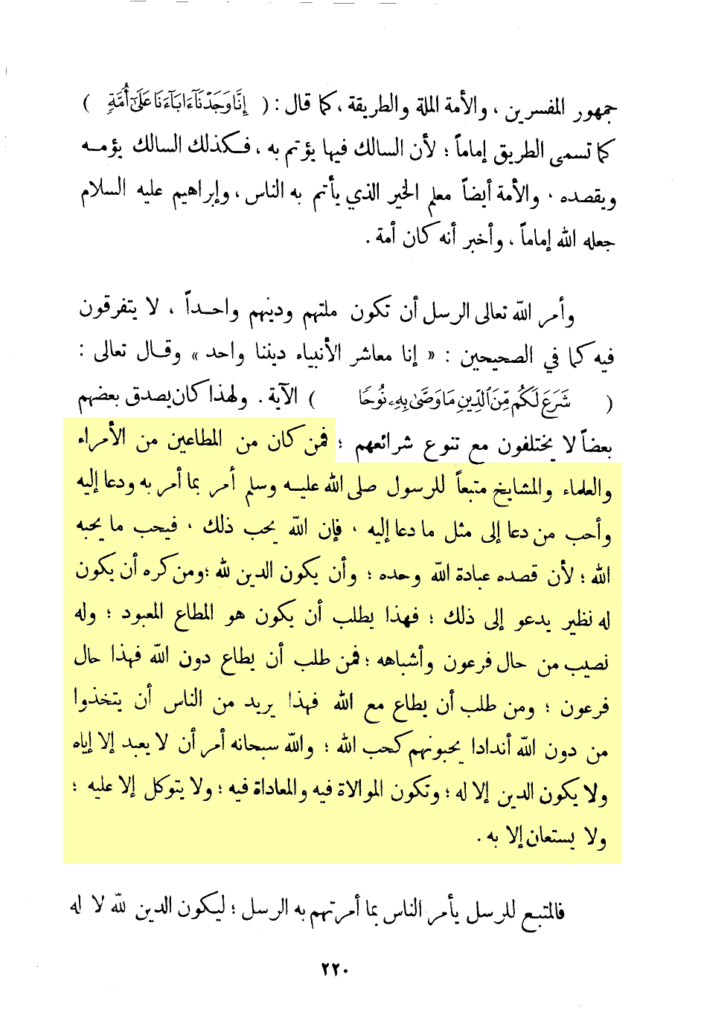
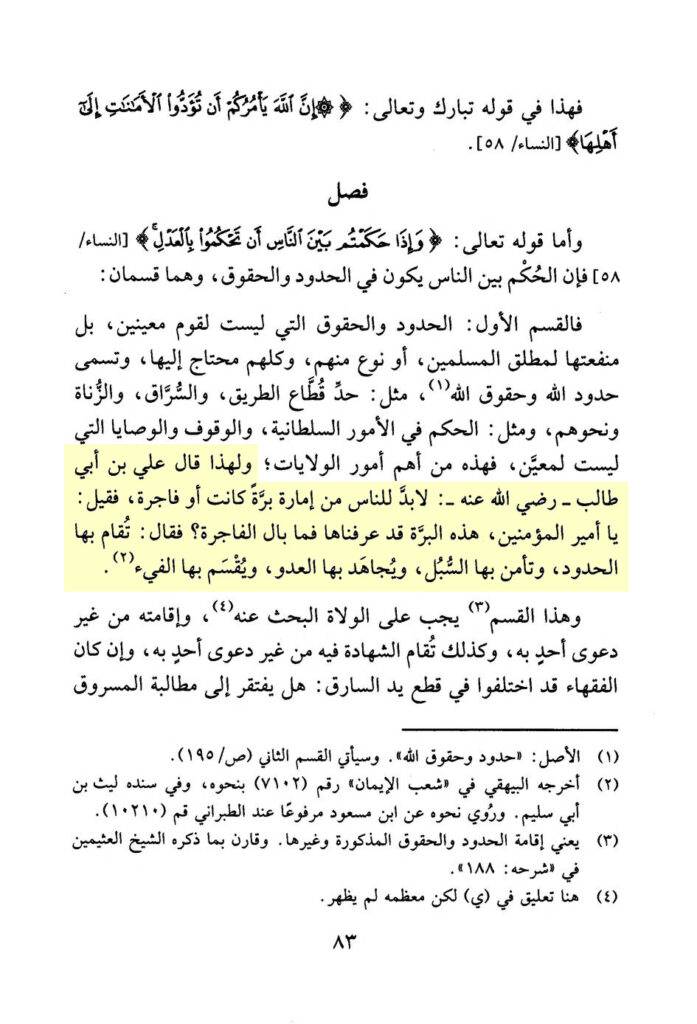
Ibn Taymīyya (d. 728 هـ) quoted ʿAlī bin Abī Ṭālib (d. 40 هـ) regarding the sinful Muslim leader:
قَالَ عَلِيُّ بْنُ أَبِي طَالِبٍ -رَضِيَ اللَّهُ عَنْهُ
ʿAlī bin Abī Ṭālib – may Allāh be pleased with him – said:
لَا بُدَّ لِلنَّاسِ مِنْ إمَارَةٍ: بَرَّةً كَانَتْ أَوْ فَاجِرَةً
There is no avoiding, for the people, an authority: whether he be righteous or immoral.
فَقِيلَ: يَا أَمِيرَ الْمُؤْمِنِينَ هَذِهِ الْبَرَّةُ قَدْ عَرَفْنَاهَا. فَمَا بَالُ الْفَاجِرَةِ؛
So it was said: O Commander of the Believers, the righteous one we have known. But what is the case of the immoral?
فَقَالَ: يُقَامُ بِهَا الْحُدُودُ، وَتَأْمَنُ بِهَا السُّبُلُ، وَيُجَاهَدُ بِهَا الْعَدُوُّ، وَيُقْسَمُ بِهَا الْفَيْءُ
He (ʿAlī bin Abī Ṭālib) said: Through him (the sinful Muslim leader) the Ḥudūd (of the Sharīʿa) are established, the roads become safe, the enemy is fought, and the Fayʾ is divided.
Ibn Taymīyya agreed with the Ahl as-Sunna on this matter and was quoted solely for this reason.
Imām Ibn Kathīr (d. 774 هـ) said about the Kitābi practice of instituting Shirk laws:
وقد كفرت هؤلاء وهؤلاء ووضعوا القوانين والأحكام
And indeed – both these and those (the Christians and the Jews) became Kuffār – and they (the Christians at the First Council of Nicaea) instituted laws (qawānīn) and rulings (aḥkām).
ومنها مخالف للعتيقة التي هي التوراة وأحلوا أشياء هي حرام بنص التوراة ومن ذلك الخنزير
And among it is what contradicts the Old (scripture), which is the Torah. And they allowed things which are Ḥarām by the literal text of the Torah, including the pig.
Imām Ibn Kathīr (d. 774 هـ) also said:
وقد خالفوا أحكام التوراة والإنجيل في غير ما شيء قد شرعوه لأنفسهم فمن ذلك صلاتهم إلى الشرق
And indeed, they contradicted the rulings (aḥkām) of the Torah and Gospel in more than one thing that they had legislated for themselves. And among that is their prayer toward the east.
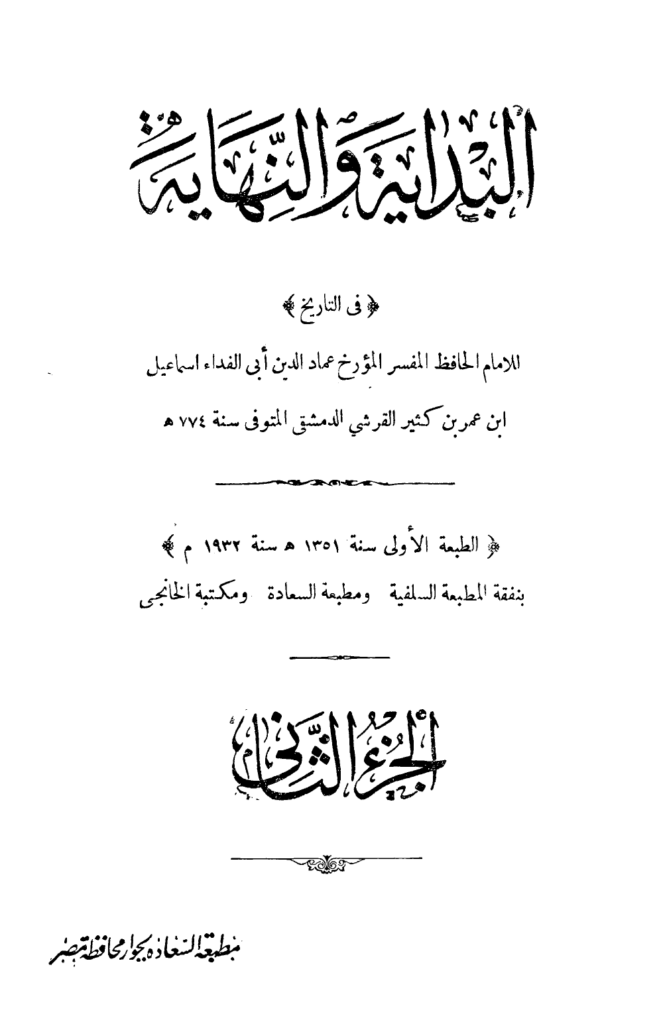
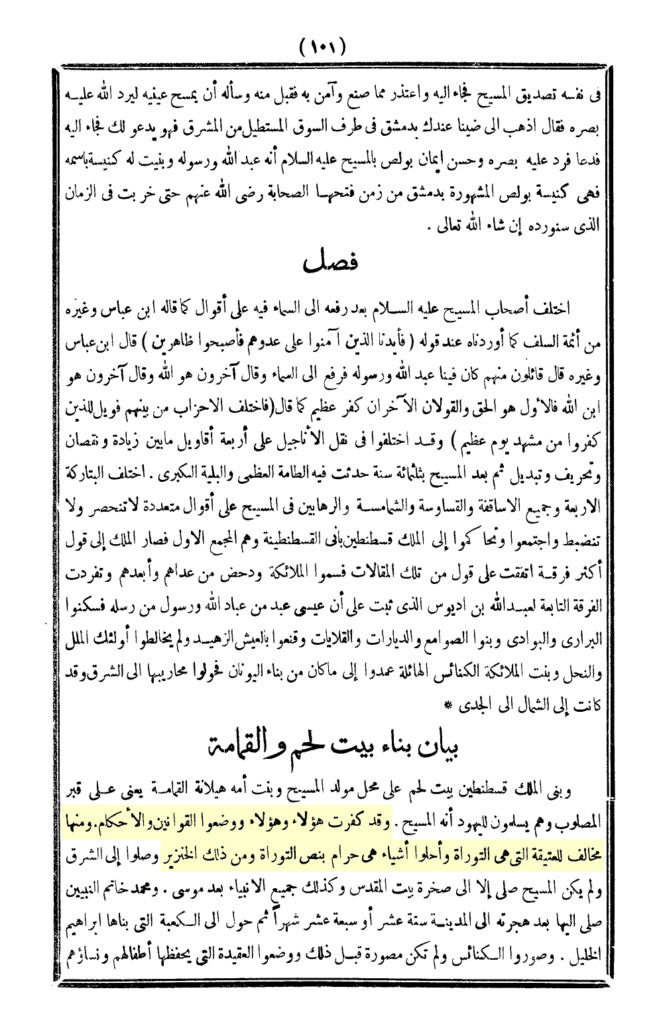
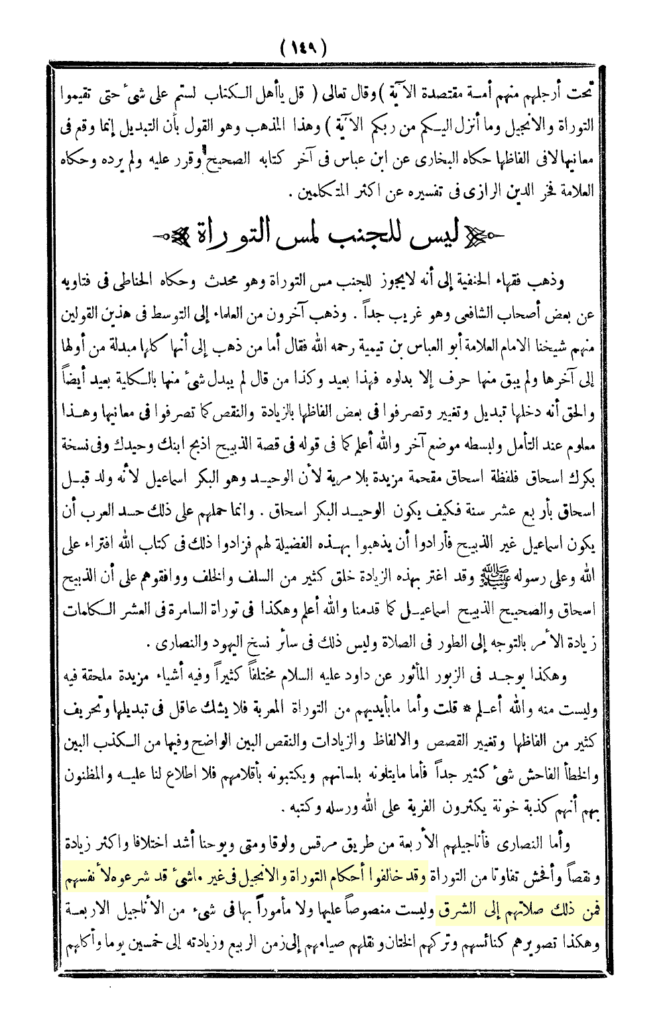
Imām Ibn Kathīr relates an account of the First Council of Nicaea, convened in 325م by the Roman Emperor Constantine I and attended by several Christian bishops. The council dealt primarily with the controversy surrounding the nature of ʿĪsā and adopted the Nicene Creed which became the foundational component of the Trinitarian doctrine.
The council proclaimed twenty so-called canons. The bishops instituted rulings that were neither revealed by God nor derived from the teachings of the Torah and the Gospel, contradicting their established rulings.
The canons (laws) were inventened through a so-called “synodal” process, in which the assembled bishops deliberated upon concrete questions and enacted binding laws. Their synod functioned as a legislative governing body that convened in the manner resembling the democratic parliaments of the present day.
The bishops regarded their synodal legislation as the exercise of authority derived from God, but did not ascribe it to revelation itself (Tabdīl). The texts employ formulations such as “this holy and great synod decrees” (Canons 8, 11, and 14) and “this great synod determines” (Canon 6).
In this respect, they resemble the rulers of the so-called Islāmic world, who similarly claim that their authority is sanctioned by Allāh insofar as they maintain that obedience to them is obligatory and that their rule may not be contested.
Allāh says:
اتَّخَذُوا أَحْبَارَهُمْ وَرُهْبَانَهُمْ أَرْبَابًا مِّن دُونِ اللَّهِ
They have taken their rabbis and monks as lords besides Allāh. [9:31]
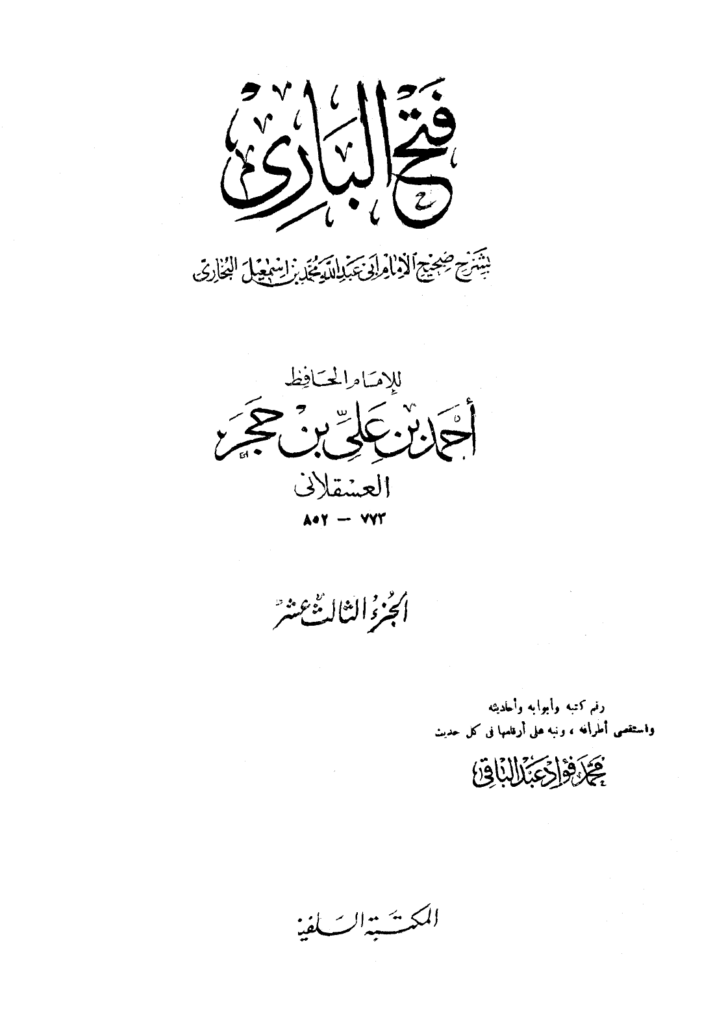
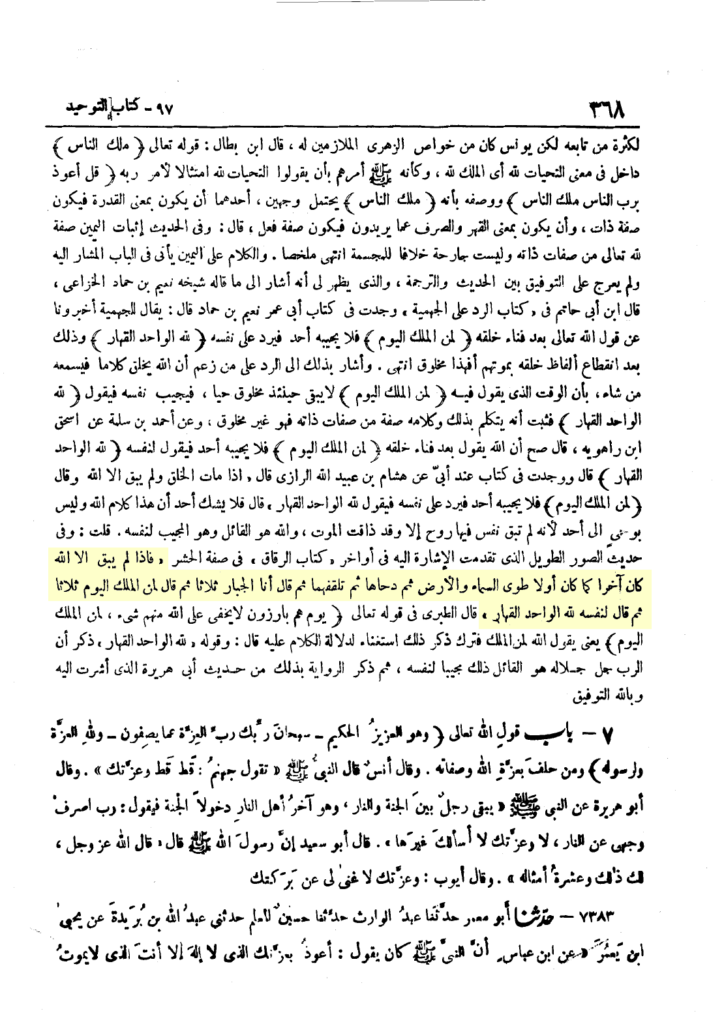
Imām Ibn Ḥajar al-ʿAsqalānī (d. 852 هـ) quoted the well-known Ḥadīth in his chapter about Tawḥīd:
فَإِذَا لَمْ يَبْقَ إِلَّا اللَّهُ – كَانَ آخِرًا كَمَا كَانَ أَوَّلًا – طَوَى السَّمَاءَ وَالْأَرْضَ، ثُمَّ دَحَاهَا، ثُمَّ تَلَقَّفَهُمَا
Then, when there remains none except Allāh – He is Last just as He is First – he folds the heavens and the earth, then He spreads it out, then He seizes them both.
ثُمَّ قَالَ: أَنَا الْجَبَّارُ ثَلَاثًا
Then He says: “I am the Compeller”, three times.
ثُمَّ قَالَ: لِمَنِ الْمُلْكُ الْيَوْمَ ثَلَاثًا
Then He says: “To whom belongs the supreme authority today?”, three times.
ثُمَّ قَالَ لِنَفْسِهِ: لِلَّهِ الْوَاحِدِ الْقَهَّارِ
Then He says to Himself: To Allāh, the One, the All-Subduing
The folding, spreading out, and seizing of the creation do not imply corporeality for Allāh.
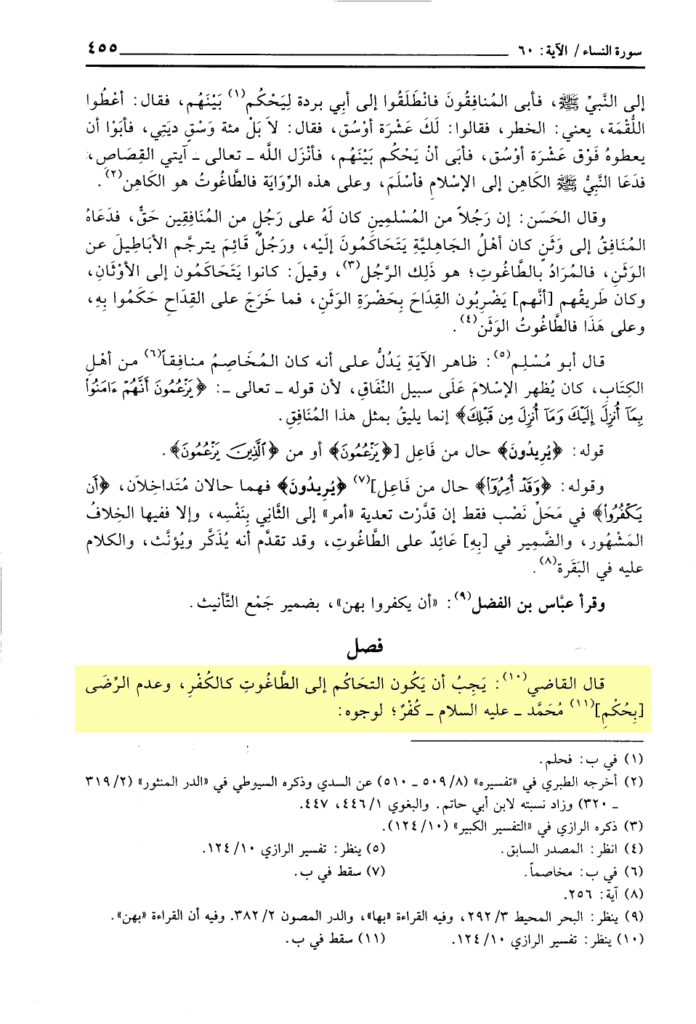
Imām Ibn ‘Ādil (d. 880 هـ) said regarding al-Kufr bit Tāghūt:
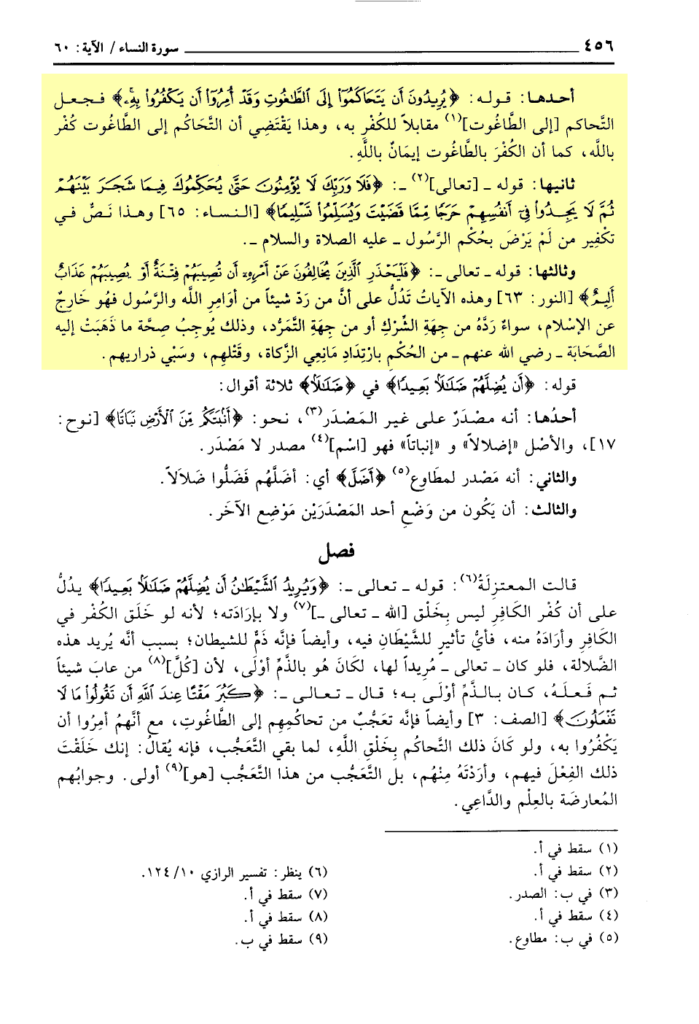
al-Qāḍī said: It is obligatory that seeking judgement (Taḥākum) from the Tāghūt is like Kufr and the absence of agreement with the judgement of Muḥammad, peace be upon him, is Kufr, for (several) reasons.
Firstly, His statement: «They want to seek judgement (Taḥākum) from the Tāghūt while they were commanded to disbelieve in him» [4:60]. Thus, He made the seeking judgement (Taḥākum) from the Tāghūt the opposite of disbelief in him. And this necessitates that the seeking judgement (Taḥākum) from the Tāghūt is Kufr in Allāh, just as the Kufr in the Tāghūt (al-Kufr bit Tāghūt) is Īmān in Allāh.
Secondly, His, Exalted is He, statement: «But no, by your Lord, they do not believe until the make you (O Muḥammad) judge in what happens between them, then they do not find in themselves (any) discomfort with what you judged and submit in full submission» [4:65]. And this is a text on the Takfīr of those who are not satisfied with the judgement of the Messenger, peace and blessings be upon him.
And thirdly, His, Exalted is He, statement: «So let those beware who violate his command (of the Prophet) that a temptation may befall them or a painful punishment may afflict them» [24:63]. And these verses indicate that whoever rejects anything from the commands of Allāh and the Messenger is outside of Islām (Kāfir), whether he rejects it from the perspective of Shirk, or from the perspective of rebellion.
And this necessitates the correctness of what the companions, may Allāh be pleased with them, believed regarding the ruling of apostasy on the withholders of the Zakāh (…).
The Tawaghit are in clear and open rebellion against the commands of Allāh and his Messenger, may Allāh’s peace and blessings be upon him, as they imprison and fight against anyone, who calls to the Sharī’a.
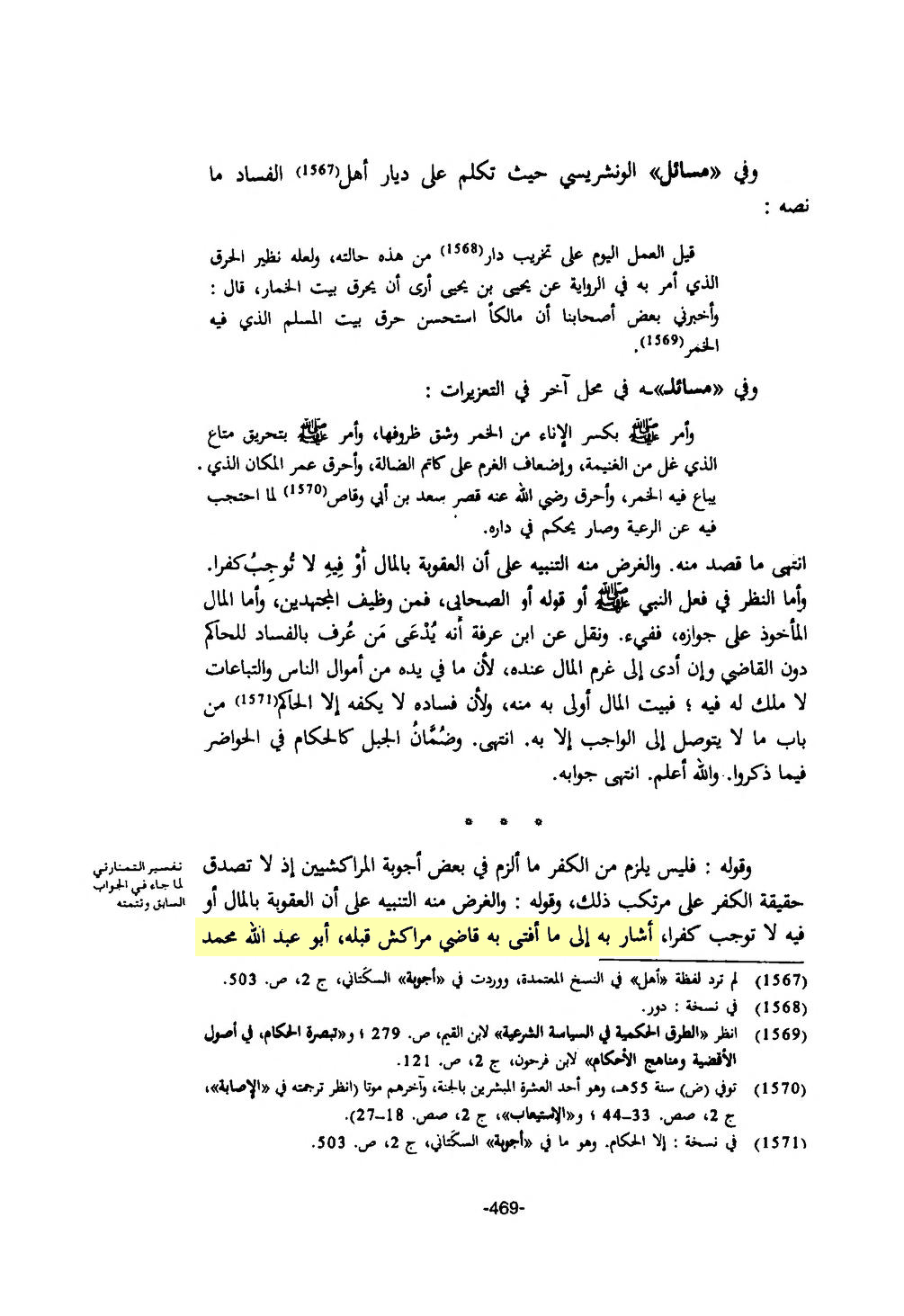
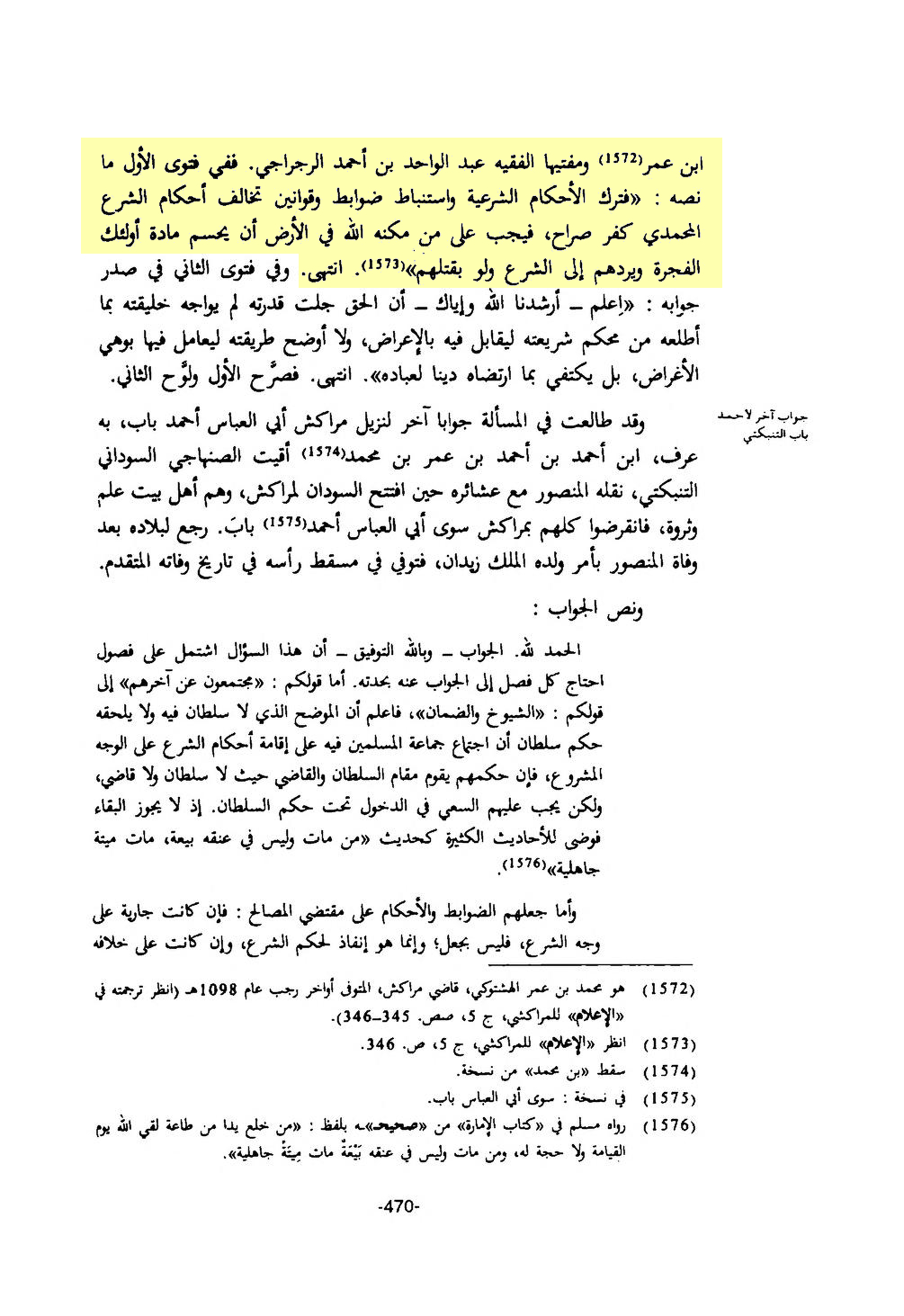
Qāḍī Abū Zayd ʿAbdurraḥmān at-Tamanārtī (d. 1060 هـ) narrated the fatwā of the qāḍī of Marrakesch, Qāḍī Abu ʿAbdullāh Muḥammad bin ʿUmar, also known as Muḥammad bin Ibrāhīm al-Hushtūki (d. 1098 هـ) on kufr laws:
أشار به إلى ما أفتى به قاضي مراكش قبله؛ أبو عبد الله محمد ابن عمر ومفتيها الفقيه عبد الواحد بن أحمد الرجراجي. ففي فتوى الأول ما نصه
He referred with that to the fatwa issued before him by the qāḍī of Marrakesh (now Morocco), Abu ʿAbdullāh Muḥammad bin ʿUmar, and his muftī, the faqīh ʿAbdulwāḥid bin Aḥmad ar-Rajrājī. In the first fatwā the wording is:
فترك الأحكام الشرعية واستنباط ضوابط وقوانين تخالف أحكام الشرع المحمدي كفر صراح فيجب على من مكنه الله في الأرض أن يحسم مادة أوليك الفجرة ويردهم إلى الشرع ولو بقتلهم
The leaving of the laws (aḥkām) of the sharī’a and invention of rules and laws that contradict the rules of the sharī’a of Muḥammad (ash-sharʿ al-muḥammadī) is obvious kufr (…)
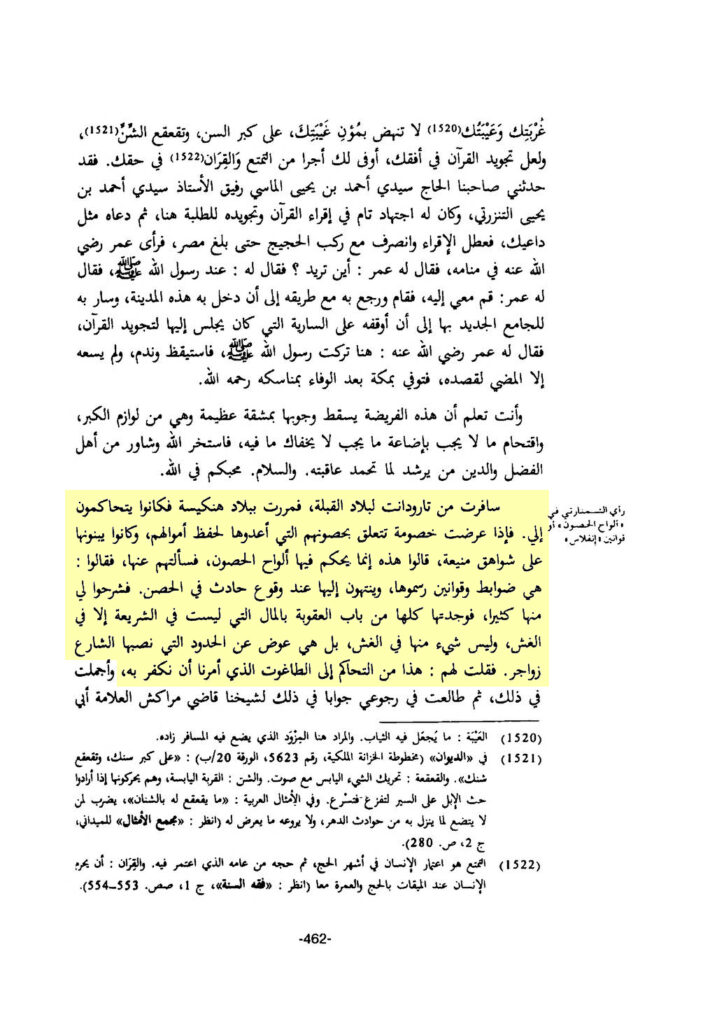
Qāḍī Abū Zayd ʿAbdurraḥmān at-Tamanārtī (gest. 1060 هـ) spoke about the Tāghūt laws of Alwāḥ al-Ḥuṣūn:
“I traveled from Taroudant (now southern Morocco) to the land of the Qibla, and so I passed through the land of Hankisa, so they used to refer to me (so that he would rule as qāḍī according to the sharī’a). So when a dispute appeared related to their forts – which they made for the protection of their wealth, and they built them on inaccessible heights – they said: ‘This is only judged by the tablets of the forts (alwāḥ al-ḥuṣūn)’ So I asked them about it and they said: ‘They are rules and laws that they have layed down and they refer to them at the occurrence of an incident in the fort’ And so they explained much of it to me. I found that all of them are from the category of wealth punishment, which is not in the sharī’a except in fraud, and nothing of it is in fraud. Rather, it is a substitute for the ḥudūd, which the legislator (Allāh) has established as deterrents. So I said to them: ‘This is from seeking a judgement (taḥākum) from the Tāghūt, which we have been commanded to make kufr against‘”
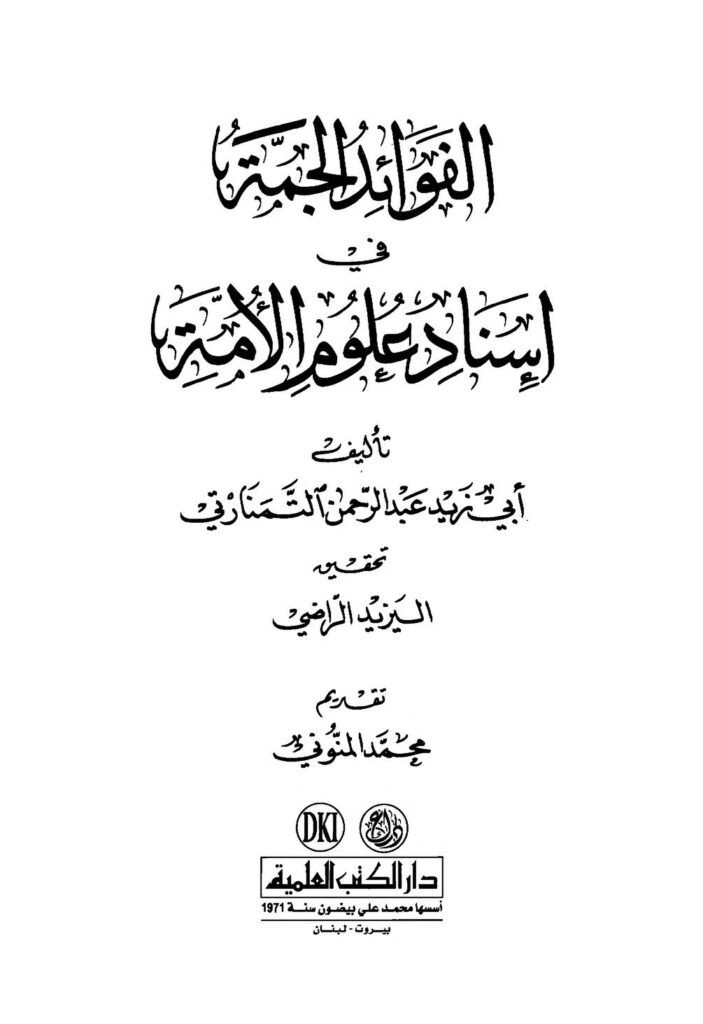
Qāḍī Abū Zayd ‘Abdurraḥmān at-Tamanārtī (d. 1060 هـ) quoted the fatwa of Qāḍī Abū al-‘Abbās Aḥmad Bābā at-Tinbuktī al-Mālikī (d. 1036 هـ) about kufr-laws:
«And whoever seeks a Dīn other than Islām, it will never be accepted from him and in the hereafter he will be among the losers» [3:85]
“And the difference is truly in the fundamentals and the branches. So it is the same whether he follows a Dīn other than it (Islām) or whether he invents rules other than its (Islām’s) rules“
Qāḍī Aḥmad at-Tinbuktī equated following a different religion with inventing laws other than the laws of Islām, the Sharī’a. According to the consensus of all Muslims, both are acts of disbelief and directly exclude a person from Islām. He did not specify that the one inventing the rules must first ascribe these kufr-rules to Islām. Instead, the mere act of Shirk sufficed the person becoming on the same level as other Kuffār.
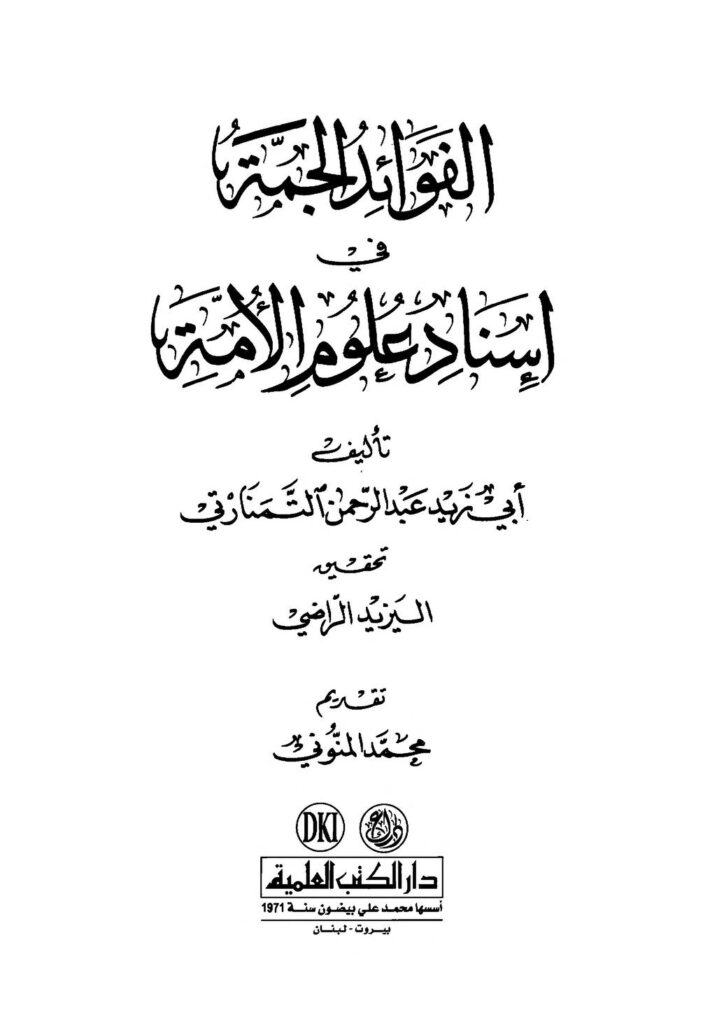
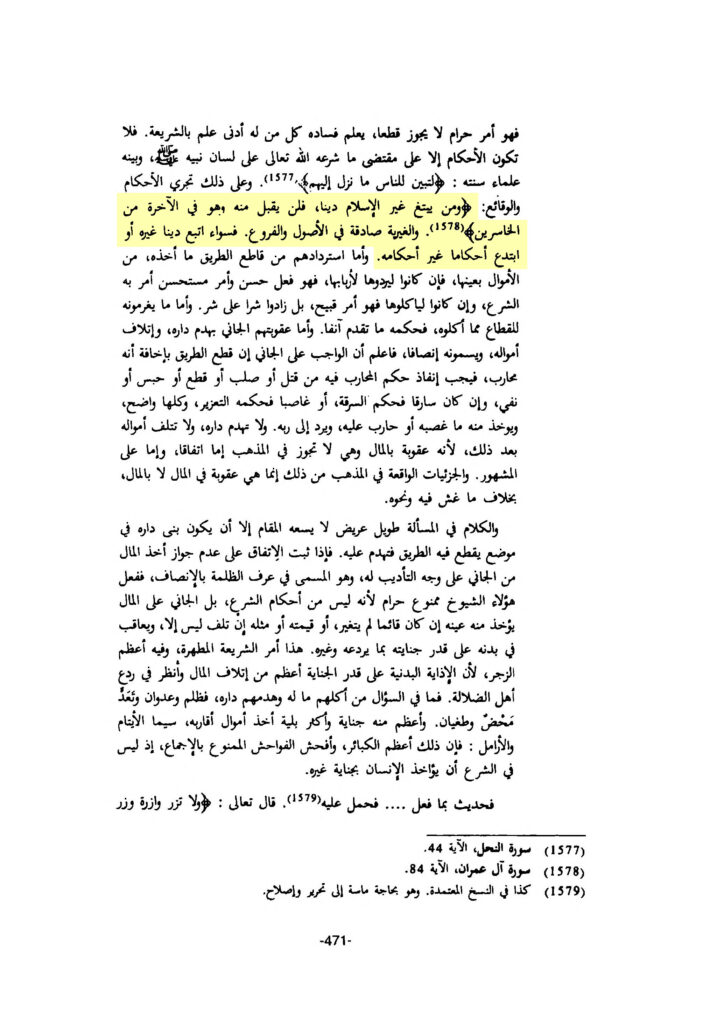
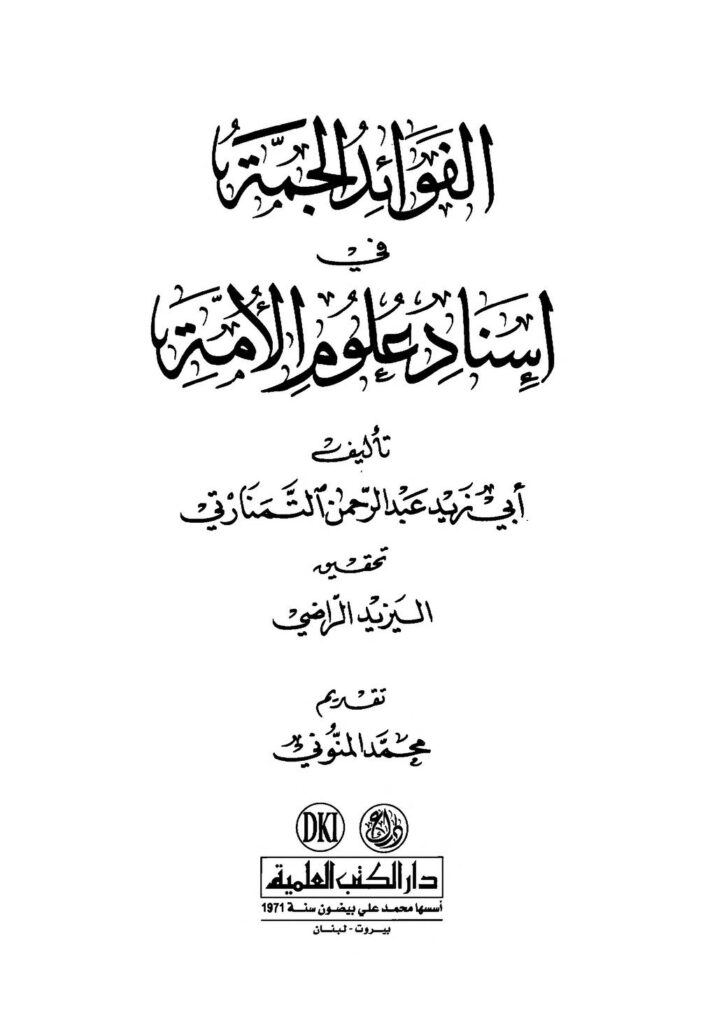
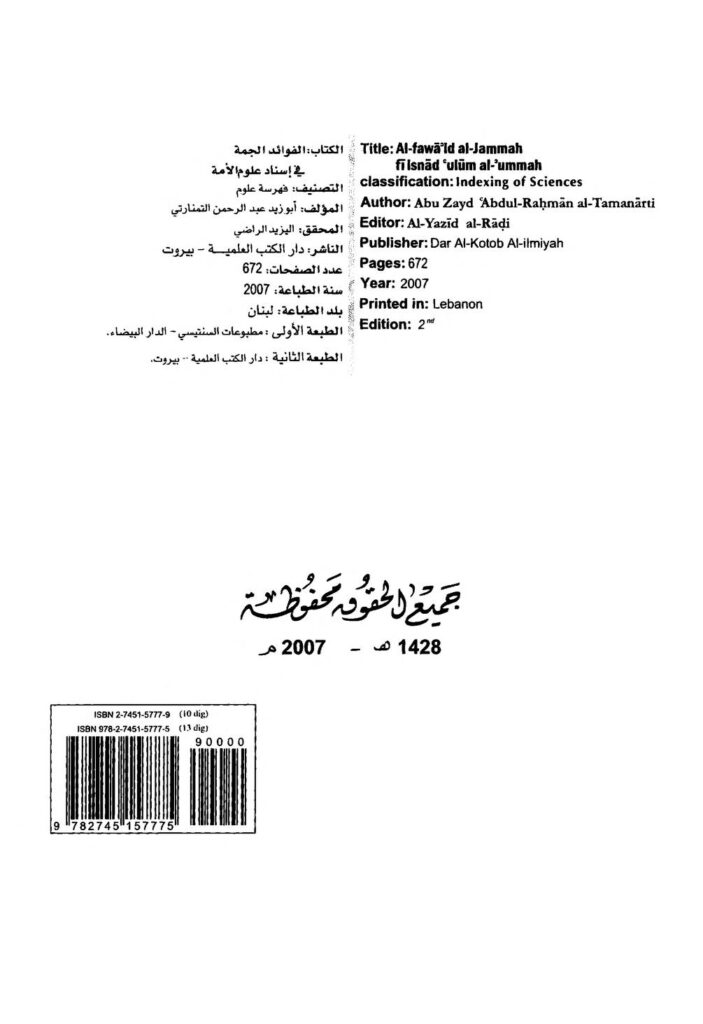
Qāḍī Abū Zayd ‘Abdurraḥmān at-Tamanārtī (d. 1060 هـ) transmitted the Fatwā of the Qāḍī of Marrakesh, Abū Mahdī ‘Īsā bin ‘Abdurraḥmān as-Suktānī al-Mālikī (d. 1062 هـ) on kufr laws:
“And as for the punishment of the criminals or their supporters by the seizure of compensation (inṣāf), that is of the financial punishments. And therein (in this type of punishment) is what is known (both) within the (Mālikī) school of law and outside of it, thus it does not constitute the changing of the law (the Sharī’a) by agreement (consensus). Therefore, it does not require the Kufr (of the person), as was required by some answers of the (scholars of) Marrakesh, because the reality of Kufr does not apply to the perpetrator (of this act)”
Qāḍī Abū Mahdī concluded that Kufr does not apply to a person as long as a law is in conformity with the Shari’a. If it is outside, and thus not in conformity with the Shari’a, then the reality of Kufr applies without any doubt. What then if not only a law, but the entire legislation has been replaced, the Shari’a has been abolished as a foundation of judgement, and secularism has been introduced? What could be a clearer Kufr then that?
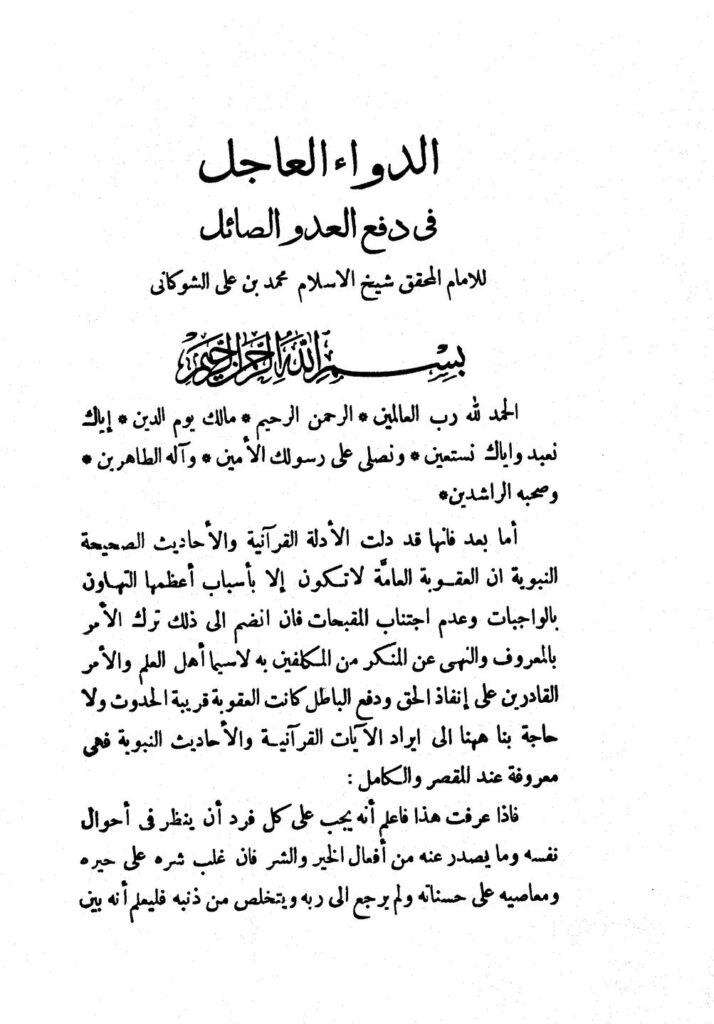
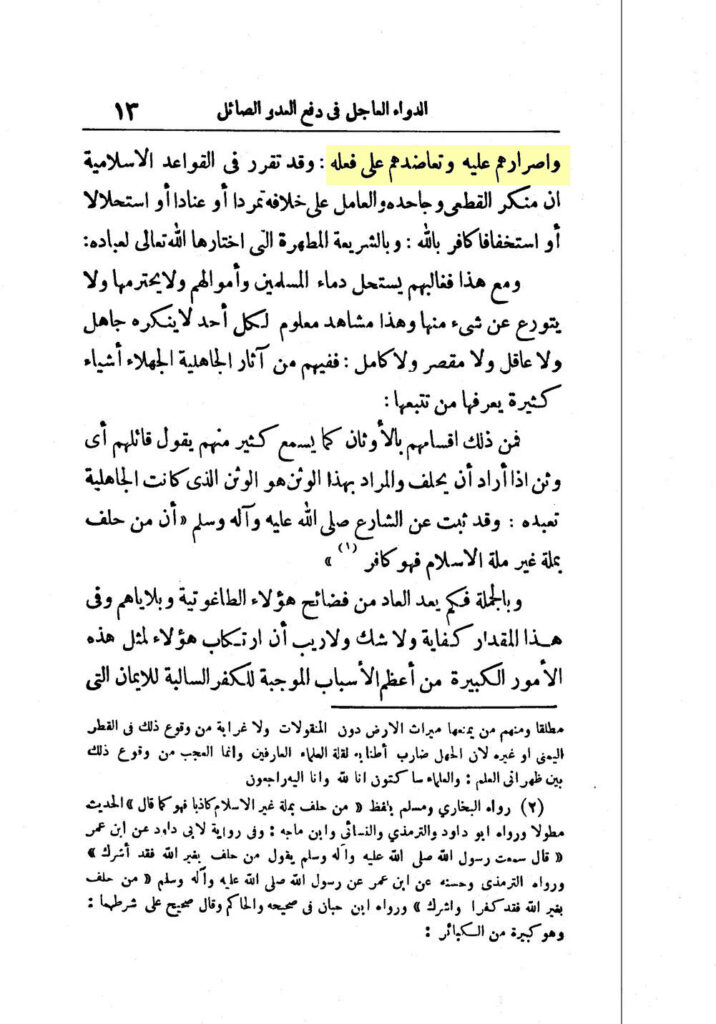
Ash-Shawkānī (d. 1250 هـ) said that those who rule with Tāghūt laws and those who accept them are Kuffār:
“Among them (the disasters which people are afflicted with) is that they rule with the Tāghūt, and they seek judgement (Taḥākum) to those who know the Tāghūt laws among them, in all matters that befall them and present themself to them. Without any disavowal (from amongst them), nor shame before Allāh, nor before His servants, nor fear of anyone. In fact, they rule by that among those who they are capable of reaching from the populace and who is near to them. And this matter is known to every one of the people, no one can deny it and push it away. And it is more well-known than a fire on a landmark (undeniable and widely known).
And there is no doubt and no uncertainty that this is Kufr in Allāh, praise be to Him, and His Sharī’a which He revealed to His Messenger and He chose it for his servants in His book and on the tongue of His Messenger, may Allāh’s peace and blessings be upon him. In fact, they are Kuffār in all of the laws from at (the time) of Ādam, peace be upon him, until now. (…) until they accept the laws of Islām, submit to them and rule among them with the purified Sharī’a.
And they leave from all of what they are in, from the satanic Tawāghīt and nevertheless they are determined on matters other than the ruling with the Tāghūt and the seeking judgement (Taḥākum) to him. And each one of them individually necessitates the Kufr of its perpetrator and his departure from Islām. And this is like their agreement on cutting the inheritance of the women, their insistence on it and their mutual support on doing it”
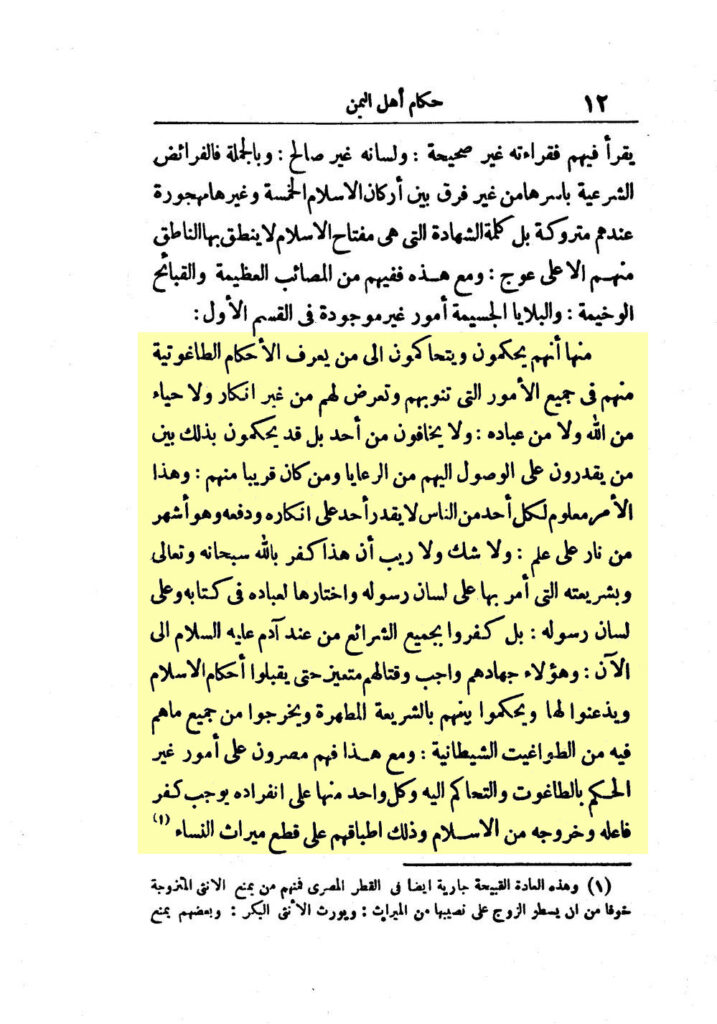
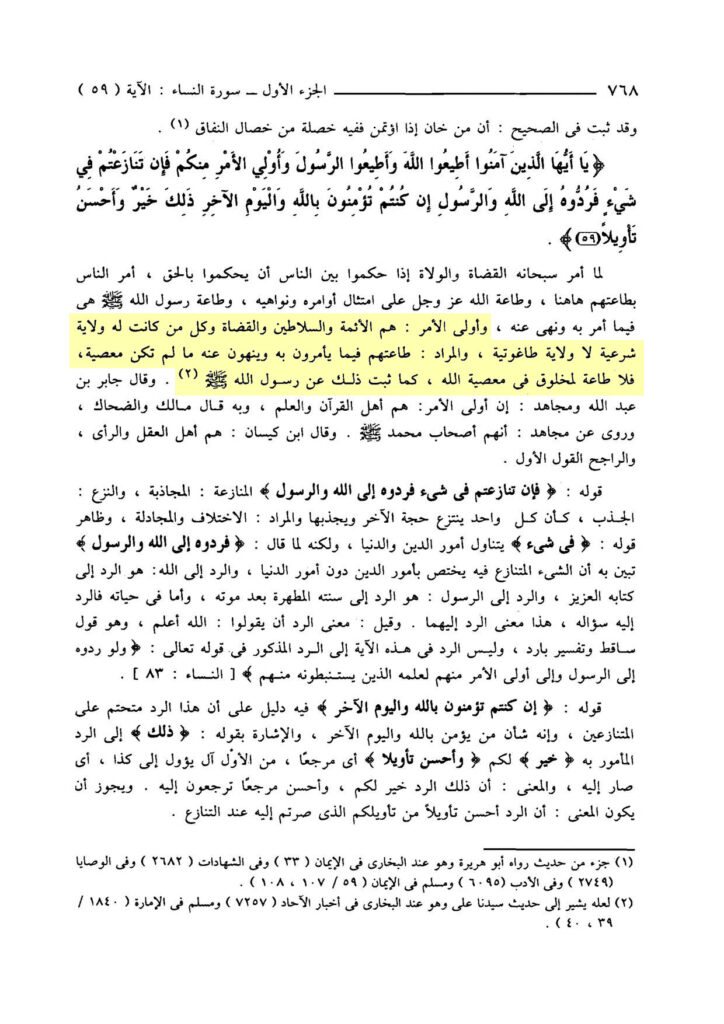
Ash-Shawkānī (d. 1250 هـ) said about those in authority and the Tāghūt:
“And those in authority (wulāt al-amr): They are the Imāms, the sultans, the judges, and anyone who has Shar’īyya authority, not Tāghūt authority (ṭāghūtiyya). And the intended (meaning) is: Their obedience in what they command and what they forbid, as long as it is not a sin. For there is no obedience to a creature in disobedience to Allāh. As was established by the Messenger of Allāh, may Allāh’s peace and blessings be upon him”
Whoever has legitimate authority according to the Sharī’a, obedience to him is obligatory in matters that are permissible. And the opposite of Sharī’a authority is Tāghūt authority, which contradicts the Sharī’a. And this statement matches with our statement that anyone who rules with laws that contradict the Sharī’a is a Tāghūt.
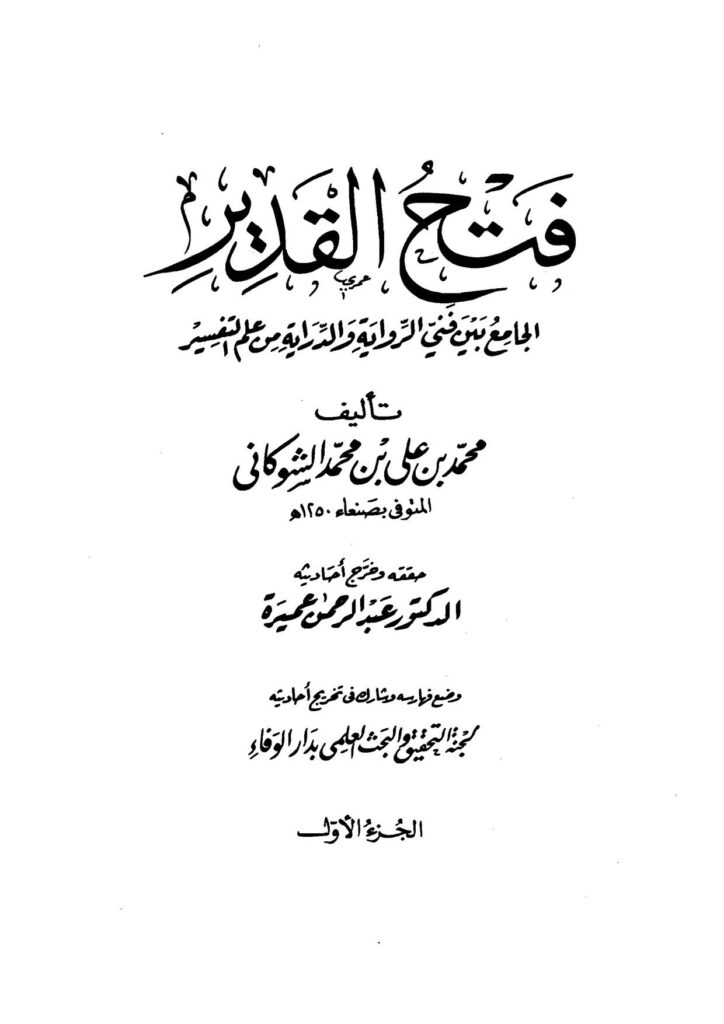
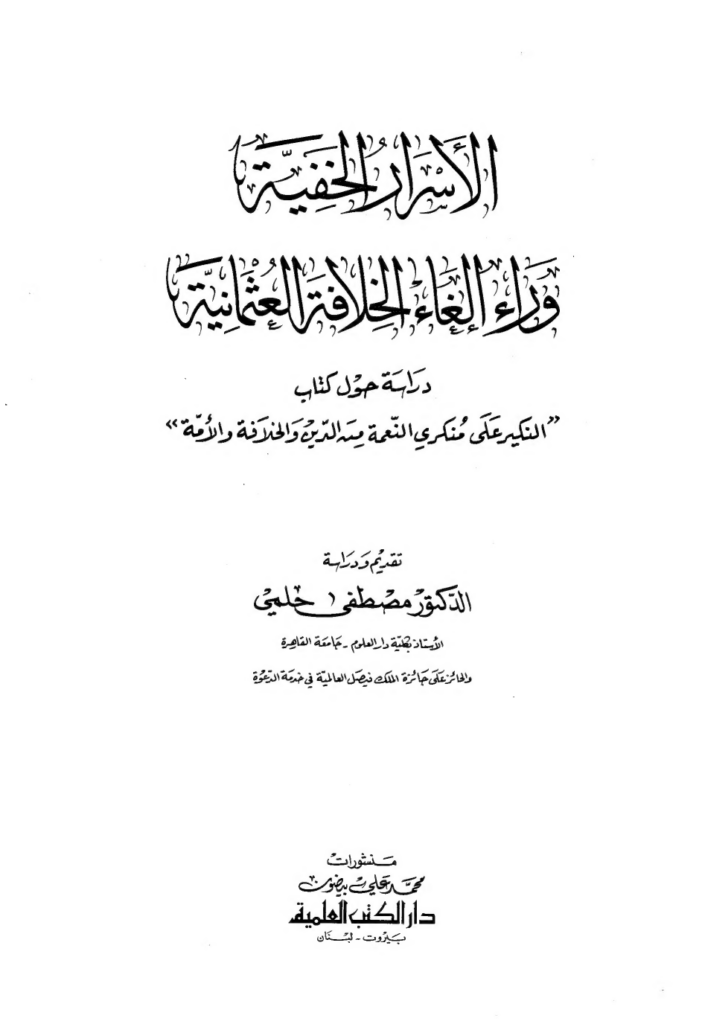
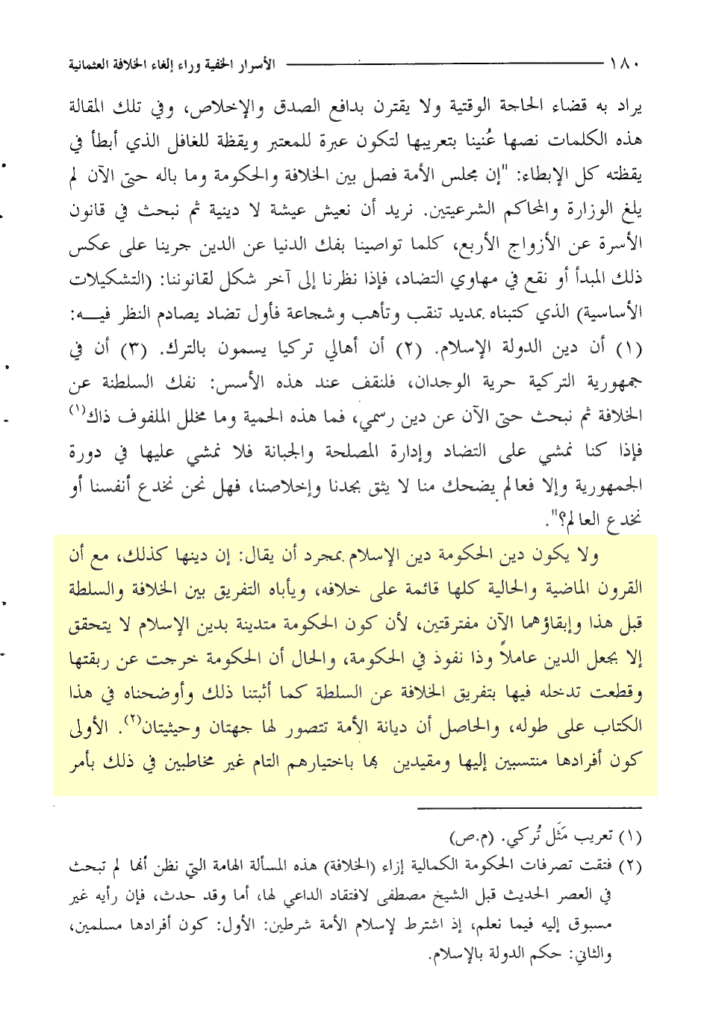
Imām Muṣṭafā Ṣabrī Efendī (d. 1373 هـ) – the second last Sheikh al-Islām of the Ottoman Empire – said:
ولا يكون دين الحكومة دين الإسلام بمجرد أن يقال: إن دينها كذلك، مع أن القرون الماضية والحالية كلها قائمة على خلافه، ويأباه التفريق بين الخلافة والسلطة قبل هذا وإبقاؤهما الآن مفترقتين
And the Dīn of the government does not become the Dīn of Islām merely by it being said that its Dīn is such, while the past and present centuries all stand upon the contrary to it. And the separation between the Caliphate and the authority before this rejects it. And keeping the both of them (Caliphate and the authority of government) now separated (refutes it).
لأن كون الحكومة متدينة بدين الإسلام لا يتحقق إلا بجعل العامل عاملاً وذا نفوذ في الحكومة، والحال أن الحكومة خرجت عن ربقتها وقطعت تدخله فيها بتفريق الخلافة عن السلطة كما أثبتنا ذلك وأوضحناه في هذا الكتاب على طوله
Because the government’s being religious with the Dīn of Islām is not realized except by making the actor (Islām) operative (Caliphate) and possessed of the authority within the government. Whereas the government has left from its bond (to Islām) and cut off its (Islām’s) intervention in it (politics) by the separation of the Caliphate from the authority, just as we have established and clarified it throughout this book.
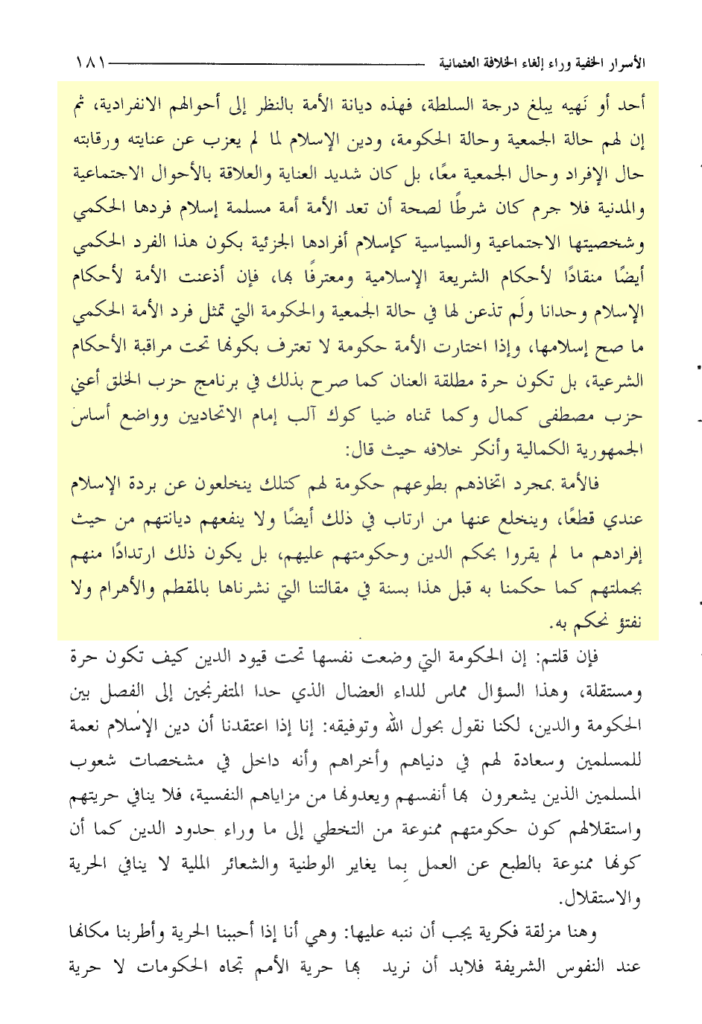
والحاصل أن ديانة الأمة تتصور لها جهتان وحيثيتان. الأولى كون أفرادها منتسبين إليها ومقيدين بها باختيارهم التام غير مخاطبين في ذلك بأمر أحد أو نهيه يبلغ درجة السلطة، فهذه ديانة الأمة بالنظر إلى أحوالهم الانفرادية
And the conclusion is that the religiosity of the Ummah is conceived as having two aspects and two considerations. The first is its individuals’ being affiliated with it (Islām) and bound by it through their full choice, without being addressed in that regard by anyone’s command or prohibition that reaches the degree of authority. This is the religiosity of the Ummah with regard to their individual conditions.
ثم إن لهم حالة الجمعية وحالة الحكومة، ودين الإسلام لما لم يعزب عن عنايته ورقابته حال الإفراد وحال الجمعية معاً، بل كان شديد العناية والعلاقة بالأحوال الاجتماعية والمدنية
Then indeed they (the Ummah) have a state of collectivity and the state of government. And since the Dīn of Islām did not leave both the individual state and the collective state from its care and its supervision – rather, it has intense concern and connection with the social and the civilian conditions.
فلا جرم كان شرطاً لصحة أن تعد الأمة أمة مسلمة إسلام فردهاً الحكمي وشخصيتها الاجتماعية والسياسية كإسلام أفرادها الجزئية يكون هذا الفرد الحكمي أيضاً منقاداً لأحكام الشريعة الإسلامية ومعترفاً بها،
Therefore, undoubtedly, it is a condition for the validity of the Ummah being considered a Muslim Ummah that, just as the Islām of particular individuals, the Islām of its juridical individual (meaning a person) and its societal and political individuality (meaning the collective) – that this juridical person (the collective) also be obedient to the rulings of the Islāmic Sharīʿa and recognizing them.
فإن أذعنت الأمة لأحكام الإسلام وحداناً ولم تذعن لها في حالة الجمعية والحكومة التي تمثل فرد الأمة الحكمي ما صح إسلامها
For indeed, if the Ummah submits to the rulings of Islām individually, but has not submitted to them (the rulings of the Sharīʿa) in the collective state and government, which represents the juridical individual of the Ummah, its Islām is not valid (they are Kuffār).
وإذا اختارت الأمة حكومة لا تعترف بكونها تحت مراقبة الأحكام الشرعية، بل تكون حرة مطلقة العنان كما صرح بذلك في برنامج حزب الخلق أعني حزب مصطفى كمال وكما تمناه ضيا كوك آلب إمام الاتحاديين وواضع أساس الجمهورية الكمالية وأنكر خلافه حيث قال
And if the Ummah chooses (iḫtāra) a government that does not recognize that it is under the control of the Sharʿī rulings, but rather is free (from the guidance of the Sharīʿa), unrestricted rein, as was proclaimed in the program of the People’s Party (Halk Fırkası. Prior name of the CHP) – I mean the party of Mustafa Kemal (Atatürk) – and as Ziya Gökalp, the (ideological) leader of the Unionists (İttihad ve Terakki) and the one who laid the foundation of the Kemalist Republic (Turkey), wished for and denied its contrary, when he said: [the words of Ziya Gökalp are missing. Alḥamdulillāh]
فالأمة بمجرد اتخاذهم بطوعهم حكومة لهم كتلك ينخلعون عن بردة الإسلام عندي قطعاً، وينخلع عنها من ارتاب في ذلك أيضاً
Thus, the Ummah, merely by their taking (as in choosing and electing – iḫtāra – as he said), through their submission, a government such as that (meaning a government that does not rule by the Sharīʿa), they without doubt, according to me, remove themselves from the mantle of Islām (they become Kuffār). And whoever doubts regarding that (that they are indeed Kuffār) also removes himself of it (Islām).
ولا ينفعهم ديانتهم من حيث إفرادهم ما لم يقروا بحكم الدين وحكومتهم عليهم، بل يكون ذلك ارتداداً منهم بجملتهم كما حكمنا به قبل هذا بسنة في مقالتنا التي نشرناها بالمقطم والأهرام ولا نفتؤ نحكم به
And their religiosity, in respect to their individuals, does not benefit them as long as they do not recognize the rule of the Dīn and its governance over them. Rather, that is apostasy (Irtidād) from them in their entirety. Just as we judged concerning it one year before this in our article which we published in al-Muqaṭṭam (a historical Cairo-based daily newspaper) and al-Ahrām (the still active, second-oldest Egyptian daily newspaper), and we do not cease judging accordingly.
In this magnificent statement Sheikh al-Islām Muṣṭafā Ṣabrī Efendī (d. 1373 هـ) outlines very important points of Tawḥīd, which both in his and our time are unconsidered by many claiming to be Muslim.
He explains in detail that the Ummah may only be considered Muslim, if they both individually and collectively submit themselves to the rule of the Sharīʿa. Their Islām is not valid, if they do not totally and entirely submit to the Dīn being entirely for Allāh in both individual and collective matters.
He – may Allāh have mercy with him – also makes clear that, by choosing – in the sense of electing (iḫtāra) – such a Shirki government, the Ummah without a doubt individually (muʿayyan) become Kuffār. The same applies to anyone who doubts that they are Kuffār.
This is because these governments are Ṭawāghīt, as they claim that their rule is superior to the rule of Allāh on earth. Choosing and electing this Shirk is in itself Shirk and constitutes approval of Kufr. Even if these Mushrikūn claim to have noble aims by worshipping other than Allāh, as they always have claimed.
Allāh says:
وَالَّذِينَ اتَّخَذُوا مِن دُونِهِ أَوْلِيَاءَ مَا نَعْبُدُهُمْ إِلَّا لِيُقَرِّبُونَا إِلَى اللَّهِ زُلْفَىٰ [39:3]
And those who take protectors besides Him (say): We only worship them that they may bring us nearer to Allāh.
And success is only by following the methodology of the last Prophet Muḥammad – may Allāh’s peace and blessings be upon him – and only through the help of Allāh.